



Click Below to Get the Code

Browse, clone, and build from real-world templates powered by Harper.
Blog
GitHub Logo

Your Website was Built for Humans. AI Needs Something Cleaner.

The web spent a decade optimizing for browsers. JavaScript-heavy rendering, dynamic CMS templates, and client-side hydration made pages beautiful and machines blind. AI answer engines retrieve, parse, and cite content directly. If your best content is trapped behind a render cycle, a cleaner source wins.
A.I.
Blog
A.I.

Your Website was Built for Humans. AI Needs Something Cleaner.

Aleks Haugom
Senior Manager of GTM
at Harper
June 18, 2026
Aleks Haugom
Senior Manager of GTM
at Harper
June 18, 2026
Aleks Haugom
Senior Manager of GTM
at Harper
June 18, 2026
June 18, 2026
The web spent a decade optimizing for browsers. JavaScript-heavy rendering, dynamic CMS templates, and client-side hydration made pages beautiful and machines blind. AI answer engines retrieve, parse, and cite content directly. If your best content is trapped behind a render cycle, a cleaner source wins.
Aleks Haugom
Senior Manager of GTM

For the last decade, the web has been optimized for people. Rich front ends. Personalization. JavaScript frameworks. Dynamic rendering. Complex CMS templates. Beautiful pages assembled from dozens of components.

That made the web more interactive. It also made the web harder for machines to understand.

In the AI era, that is a serious problem.

Buyers are no longer only discovering products through traditional search results. They are asking ChatGPT, Perplexity, Gemini, Claude, Copilot, and internal enterprise assistants for answers. They want summaries, comparisons, recommendations, implementation guidance, and trusted sources. Increasingly, the first impression of your company may not happen on your website. It may happen inside an AI-generated answer.

That changes the job of content.

Your content does not just need to rank. It needs to be retrieved, parsed, understood, summarized, and cited.

That is the shift from SEO to AEO: Answer Engine Optimization.

The problem: your best content may be trapped inside the wrong format

Many modern websites bury important information inside JavaScript-heavy experiences. The page may look great to a human in a browser, but the actual content may require client-side rendering, API calls, hydration, routing logic, or DOM reconstruction before it becomes visible.

Google’s own guidance on JavaScript SEO basics describes crawling, rendering, and indexing as distinct phases. In other words, if the meaningful content is not present until JavaScript runs, there is another step between the crawler and the answer.

Google’s guidance on dynamic rendering also makes the point clearly: dynamic rendering is a workaround, not a long-term solution. Google recommends server-side rendering, static rendering, or hydration instead.

That is the warning shot.

AI systems are not all Googlebot. Some use search indexes. Some fetch pages directly. Some rely on partner indexes. Some crawl with limited rendering. Some strip pages down to text. Some chunk content for retrieval. Some summarize whatever they can access and move on.

So the practical question is not, “Can AI ever read JavaScript?”

The better question is:

Why are we making machines work so hard to understand our most important content?
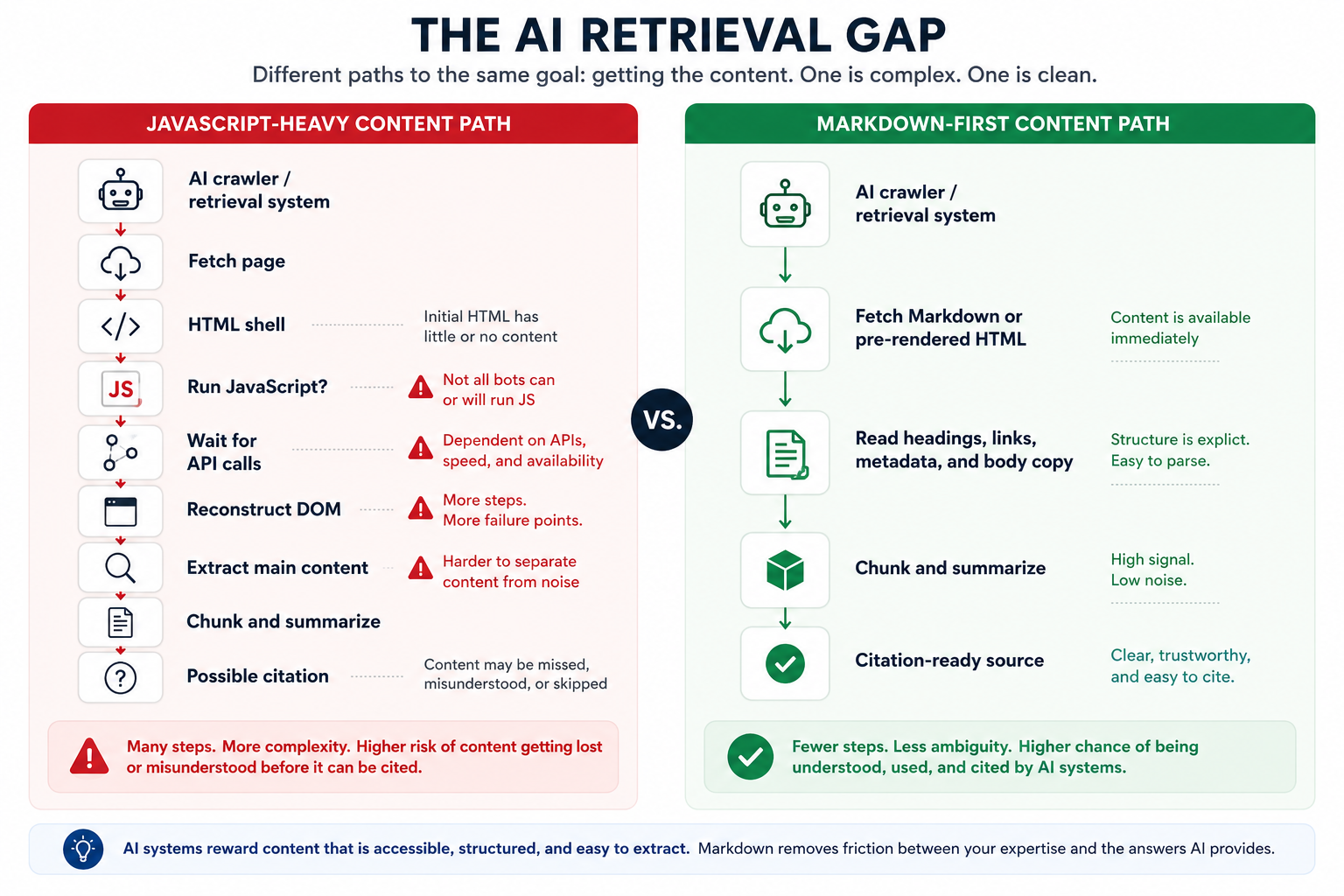
JavaScript-heavy sites add rendering and extraction steps. Markdown gives AI systems a cleaner path to access, understand, and cite your content.

If your answer, product explanation, comparison page, documentation, or partner story is buried behind a dynamic web experience, there is a chance an AI system misses it, misunderstands it, or chooses a cleaner source instead.

Markdown is becoming the machine-readable content layer

Markdown matters now because it is simple, structured, and easy for both humans and machines to read.

A good Markdown page makes the hierarchy obvious. The title is clear. Headings define the structure. Links preserve context. Lists separate key points. Code blocks remain intact. Metadata can travel with the content. There is less visual noise, less layout baggage, and less ambiguity.

That makes Markdown a strong foundation for AEO.

It is not a magic citation button. There is no credible universal metric that says “Markdown increases AI citations by X%.” But there is a clear direction of travel: AI systems reward content that is accessible, structured, semantically clear, and easy to retrieve. Markdown gives teams a practical way to create that kind of source material.

The rise of llms.txt points in the same direction. The proposal recommends adding a Markdown file to websites to provide LLM-friendly background, guidance, and links to detailed Markdown files. Whether or not llms.txt becomes a formal standard, the signal is obvious: companies are looking for ways to give AI systems cleaner entry points into their content.

This is bigger than publishing

Most teams do not need “a Markdown website.” They need a reliable way to make authoritative content available to humans, search engines, and AI systems at the same time.

That means:

  • Rendered pages for people
  • Clean HTML for search engines
  • Markdown or Markdown-like source files for AI retrieval
  • Curated maps like llms.txt
  • Fast global delivery
  • A path to connect content with application logic, data, caching, and personalization

That is where Harper becomes exciting.

With Harper on Fabric, Markdown can become more than a static file format. It can become a distributed content service.

Harper fetches existing pages, converts them into clean Markdown, caches them, and serves AI-ready content globally from Fabric.

A team can write content in Markdown, render it into fast pages, expose clean machine-readable versions, and deploy the experience geographically. That matters because AI-era content needs to be both understandable and available. If machines are retrieving, parsing, and citing your material, latency and consistency still matter.

Even better, Harper is not limited to one Markdown component. Multiple components can run together on a single Harper instance. A Markdown rendering service can sit alongside APIs, caching, data access, messaging, personalization, or other application logic. That gives teams a lightweight starting point with room to grow into a broader distributed application architecture.

Where this fits against point solutions

Tools like Botify and other SEO platforms can help teams analyze crawlability, search performance, and technical SEO issues. Those are valuable capabilities. But analysis is not the same as architecture.

The bigger opportunity is to build the content layer correctly in the first place.

Harper gives teams a way to serve AI-readable content as part of the application itself. Instead of bolting on a rendering workaround after the website becomes hard to crawl, teams can create clean, structured, distributed content from the start.

That is a better posture for the AI era.

This also aligns naturally with Akamai’s edge strategy. Akamai’s EdgeWorkers documentation describes running JavaScript at the edge, close to users, with automatic scaling. Harper complements that conversation by giving teams a distributed application platform where Markdown rendering can sit alongside data, APIs, caching, and other application components.

The takeaway

The future of content performance is not only page speed. It is retrieval speed. Extraction clarity. Citation readiness. Machine comprehension.

Your website is no longer just a destination. It is a source of truth for answer engines.

Markdown gives that source of truth a clean structure. Harper Fabric gives it a distributed runtime.

For teams that want their content to be found, understood, and used by AI systems, that combination is powerful.

Technical teams can start here: Harper Markdown pre-rendering template.

The companies that win in AEO will not be the ones that make AI systems dig through the most complexity. They will be the ones that make their expertise the easiest to retrieve, trust, and cite.

For the last decade, the web has been optimized for people. Rich front ends. Personalization. JavaScript frameworks. Dynamic rendering. Complex CMS templates. Beautiful pages assembled from dozens of components.

That made the web more interactive. It also made the web harder for machines to understand.

In the AI era, that is a serious problem.

Buyers are no longer only discovering products through traditional search results. They are asking ChatGPT, Perplexity, Gemini, Claude, Copilot, and internal enterprise assistants for answers. They want summaries, comparisons, recommendations, implementation guidance, and trusted sources. Increasingly, the first impression of your company may not happen on your website. It may happen inside an AI-generated answer.

That changes the job of content.

Your content does not just need to rank. It needs to be retrieved, parsed, understood, summarized, and cited.

That is the shift from SEO to AEO: Answer Engine Optimization.

The problem: your best content may be trapped inside the wrong format

Many modern websites bury important information inside JavaScript-heavy experiences. The page may look great to a human in a browser, but the actual content may require client-side rendering, API calls, hydration, routing logic, or DOM reconstruction before it becomes visible.

Google’s own guidance on JavaScript SEO basics describes crawling, rendering, and indexing as distinct phases. In other words, if the meaningful content is not present until JavaScript runs, there is another step between the crawler and the answer.

Google’s guidance on dynamic rendering also makes the point clearly: dynamic rendering is a workaround, not a long-term solution. Google recommends server-side rendering, static rendering, or hydration instead.

That is the warning shot.

AI systems are not all Googlebot. Some use search indexes. Some fetch pages directly. Some rely on partner indexes. Some crawl with limited rendering. Some strip pages down to text. Some chunk content for retrieval. Some summarize whatever they can access and move on.

So the practical question is not, “Can AI ever read JavaScript?”

The better question is:

Why are we making machines work so hard to understand our most important content?

JavaScript-heavy sites add rendering and extraction steps. Markdown gives AI systems a cleaner path to access, understand, and cite your content.

If your answer, product explanation, comparison page, documentation, or partner story is buried behind a dynamic web experience, there is a chance an AI system misses it, misunderstands it, or chooses a cleaner source instead.

Markdown is becoming the machine-readable content layer

Markdown matters now because it is simple, structured, and easy for both humans and machines to read.

A good Markdown page makes the hierarchy obvious. The title is clear. Headings define the structure. Links preserve context. Lists separate key points. Code blocks remain intact. Metadata can travel with the content. There is less visual noise, less layout baggage, and less ambiguity.

That makes Markdown a strong foundation for AEO.

It is not a magic citation button. There is no credible universal metric that says “Markdown increases AI citations by X%.” But there is a clear direction of travel: AI systems reward content that is accessible, structured, semantically clear, and easy to retrieve. Markdown gives teams a practical way to create that kind of source material.

The rise of llms.txt points in the same direction. The proposal recommends adding a Markdown file to websites to provide LLM-friendly background, guidance, and links to detailed Markdown files. Whether or not llms.txt becomes a formal standard, the signal is obvious: companies are looking for ways to give AI systems cleaner entry points into their content.

This is bigger than publishing

Most teams do not need “a Markdown website.” They need a reliable way to make authoritative content available to humans, search engines, and AI systems at the same time.

That means:

  • Rendered pages for people
  • Clean HTML for search engines
  • Markdown or Markdown-like source files for AI retrieval
  • Curated maps like llms.txt
  • Fast global delivery
  • A path to connect content with application logic, data, caching, and personalization

That is where Harper becomes exciting.

With Harper on Fabric, Markdown can become more than a static file format. It can become a distributed content service.

Harper fetches existing pages, converts them into clean Markdown, caches them, and serves AI-ready content globally from Fabric.

A team can write content in Markdown, render it into fast pages, expose clean machine-readable versions, and deploy the experience geographically. That matters because AI-era content needs to be both understandable and available. If machines are retrieving, parsing, and citing your material, latency and consistency still matter.

Even better, Harper is not limited to one Markdown component. Multiple components can run together on a single Harper instance. A Markdown rendering service can sit alongside APIs, caching, data access, messaging, personalization, or other application logic. That gives teams a lightweight starting point with room to grow into a broader distributed application architecture.

Where this fits against point solutions

Tools like Botify and other SEO platforms can help teams analyze crawlability, search performance, and technical SEO issues. Those are valuable capabilities. But analysis is not the same as architecture.

The bigger opportunity is to build the content layer correctly in the first place.

Harper gives teams a way to serve AI-readable content as part of the application itself. Instead of bolting on a rendering workaround after the website becomes hard to crawl, teams can create clean, structured, distributed content from the start.

That is a better posture for the AI era.

This also aligns naturally with Akamai’s edge strategy. Akamai’s EdgeWorkers documentation describes running JavaScript at the edge, close to users, with automatic scaling. Harper complements that conversation by giving teams a distributed application platform where Markdown rendering can sit alongside data, APIs, caching, and other application components.

The takeaway

The future of content performance is not only page speed. It is retrieval speed. Extraction clarity. Citation readiness. Machine comprehension.

Your website is no longer just a destination. It is a source of truth for answer engines.

Markdown gives that source of truth a clean structure. Harper Fabric gives it a distributed runtime.

For teams that want their content to be found, understood, and used by AI systems, that combination is powerful.

Technical teams can start here: Harper Markdown pre-rendering template.

The companies that win in AEO will not be the ones that make AI systems dig through the most complexity. They will be the ones that make their expertise the easiest to retrieve, trust, and cite.

The web spent a decade optimizing for browsers. JavaScript-heavy rendering, dynamic CMS templates, and client-side hydration made pages beautiful and machines blind. AI answer engines retrieve, parse, and cite content directly. If your best content is trapped behind a render cycle, a cleaner source wins.

Download

White arrow pointing right
The web spent a decade optimizing for browsers. JavaScript-heavy rendering, dynamic CMS templates, and client-side hydration made pages beautiful and machines blind. AI answer engines retrieve, parse, and cite content directly. If your best content is trapped behind a render cycle, a cleaner source wins.

Download

White arrow pointing right
The web spent a decade optimizing for browsers. JavaScript-heavy rendering, dynamic CMS templates, and client-side hydration made pages beautiful and machines blind. AI answer engines retrieve, parse, and cite content directly. If your best content is trapped behind a render cycle, a cleaner source wins.

Download

White arrow pointing right

Explore Recent Resources

Blog
GitHub Logo

Your Website was Built for Humans. AI Needs Something Cleaner.

The web spent a decade optimizing for browsers. JavaScript-heavy rendering, dynamic CMS templates, and client-side hydration made pages beautiful and machines blind. AI answer engines retrieve, parse, and cite content directly. If your best content is trapped behind a render cycle, a cleaner source wins.
A.I.
Blog
The web spent a decade optimizing for browsers. JavaScript-heavy rendering, dynamic CMS templates, and client-side hydration made pages beautiful and machines blind. AI answer engines retrieve, parse, and cite content directly. If your best content is trapped behind a render cycle, a cleaner source wins.
Person with short dark hair and moustache, wearing a colorful plaid shirt, smiling outdoors in a forested mountain landscape.
Aleks Haugom
Senior Manager of GTM
Blog

Your Website was Built for Humans. AI Needs Something Cleaner.

The web spent a decade optimizing for browsers. JavaScript-heavy rendering, dynamic CMS templates, and client-side hydration made pages beautiful and machines blind. AI answer engines retrieve, parse, and cite content directly. If your best content is trapped behind a render cycle, a cleaner source wins.
Aleks Haugom
Jun 2026
Blog

Your Website was Built for Humans. AI Needs Something Cleaner.

The web spent a decade optimizing for browsers. JavaScript-heavy rendering, dynamic CMS templates, and client-side hydration made pages beautiful and machines blind. AI answer engines retrieve, parse, and cite content directly. If your best content is trapped behind a render cycle, a cleaner source wins.
Aleks Haugom
Blog

Your Website was Built for Humans. AI Needs Something Cleaner.

The web spent a decade optimizing for browsers. JavaScript-heavy rendering, dynamic CMS templates, and client-side hydration made pages beautiful and machines blind. AI answer engines retrieve, parse, and cite content directly. If your best content is trapped behind a render cycle, a cleaner source wins.
Aleks Haugom
Tutorial
GitHub Logo

Harper's AI Stack: Models API, Agent Loop, and Built-in Agent

Harper 5.1 ships three layered AI capabilities: a provider-agnostic Models API supporting OpenAI, Anthropic, Bedrock, and Ollama; a built-in agentic loop via toolMode: 'auto' with hard budget controls; and an opt-in Harper Agent component. Switching providers is a config change, not a code change.
A.I.
Tutorial
Harper 5.1 ships three layered AI capabilities: a provider-agnostic Models API supporting OpenAI, Anthropic, Bedrock, and Ollama; a built-in agentic loop via toolMode: 'auto' with hard budget controls; and an opt-in Harper Agent component. Switching providers is a config change, not a code change.
Person with very short blonde hair wearing a light gray button‑up shirt, standing with arms crossed and smiling outdoors with foliage behind.
Kris Zyp
SVP of Engineering
Tutorial

Harper's AI Stack: Models API, Agent Loop, and Built-in Agent

Harper 5.1 ships three layered AI capabilities: a provider-agnostic Models API supporting OpenAI, Anthropic, Bedrock, and Ollama; a built-in agentic loop via toolMode: 'auto' with hard budget controls; and an opt-in Harper Agent component. Switching providers is a config change, not a code change.
Kris Zyp
Jun 2026
Tutorial

Harper's AI Stack: Models API, Agent Loop, and Built-in Agent

Harper 5.1 ships three layered AI capabilities: a provider-agnostic Models API supporting OpenAI, Anthropic, Bedrock, and Ollama; a built-in agentic loop via toolMode: 'auto' with hard budget controls; and an opt-in Harper Agent component. Switching providers is a config change, not a code change.
Kris Zyp
Tutorial

Harper's AI Stack: Models API, Agent Loop, and Built-in Agent

Harper 5.1 ships three layered AI capabilities: a provider-agnostic Models API supporting OpenAI, Anthropic, Bedrock, and Ollama; a built-in agentic loop via toolMode: 'auto' with hard budget controls; and an opt-in Harper Agent component. Switching providers is a config change, not a code change.
Kris Zyp