



Click Below to Get the Code

Browse, clone, and build from real-world templates powered by Harper.
Comparison
GitHub Logo

Normalized vs. Denormalized Lookup Speed Comparison

Harper enables normalized data to be a practical storage solution with minimal impact on read performance.
Comparison

Normalized vs. Denormalized Lookup Speed Comparison

Harper
at Harper
June 11, 2025
Harper
at Harper
June 11, 2025
Harper
at Harper
June 11, 2025
June 11, 2025
Harper enables normalized data to be a practical storage solution with minimal impact on read performance.
Harper

Data Model Overview 

Normalized Data

Normalized data is organized into tables, each representing a specific type of information. This structure divides data into logical groups to minimize redundancy and ensure consistency. Relationships between tables are established through keys, allowing for efficient data retrieval and updating. Normalized data models help ensure data integrity and reduce the risk of errors or inconsistencies in the data.

Denormalized Data

Denormalized data combines multiple types of data into a single table. This can result in data duplication and a larger table size. Accordingly, it consumes more of a database's in-memory cache. It can also increase the risk of inconsistencies in the data and make updates more resource-intensive since data needs to be updated in multiple locations. Historically, the upside to denormalization is lookup speed because the system just needs to perform one look-up rather than multiple. 

Summary of Results

  • Normalized data’s performance scales significantly better.
  • Denormalized data’s speed advantage drops off when the size on disk exceeds system RAM.
  • On average, normalized data has 12.12 times more throughput on write than denormalized. 
  • On average, denormalized data is 13.1 times larger than normalized data on disk.  

Performance was compared for normalized and denormalized data models. Multiple tests were run against datasets of increasing size and with increasing user concurrency on a single server. 

Datasets were intended to simulate various user counts, starting with 20,000 users and increasing by an order of magnitude for each test, with a final simulation of 200,000,000 users. Each user has 150 entitlements that represent purchases of various digital items. Entitlements were stored as part of the user’s record when testing the denormalized data model and as a separate table while testing normalized data. 

Entitlements were randomly selected from a pool of entitlements that varied in size based on the user base. The number of entitlements was 10% of the number of users. For example, when testing 20 million users, a list of 2 million potential entitlements was created, then each user was associated with 150 of those entitlements.

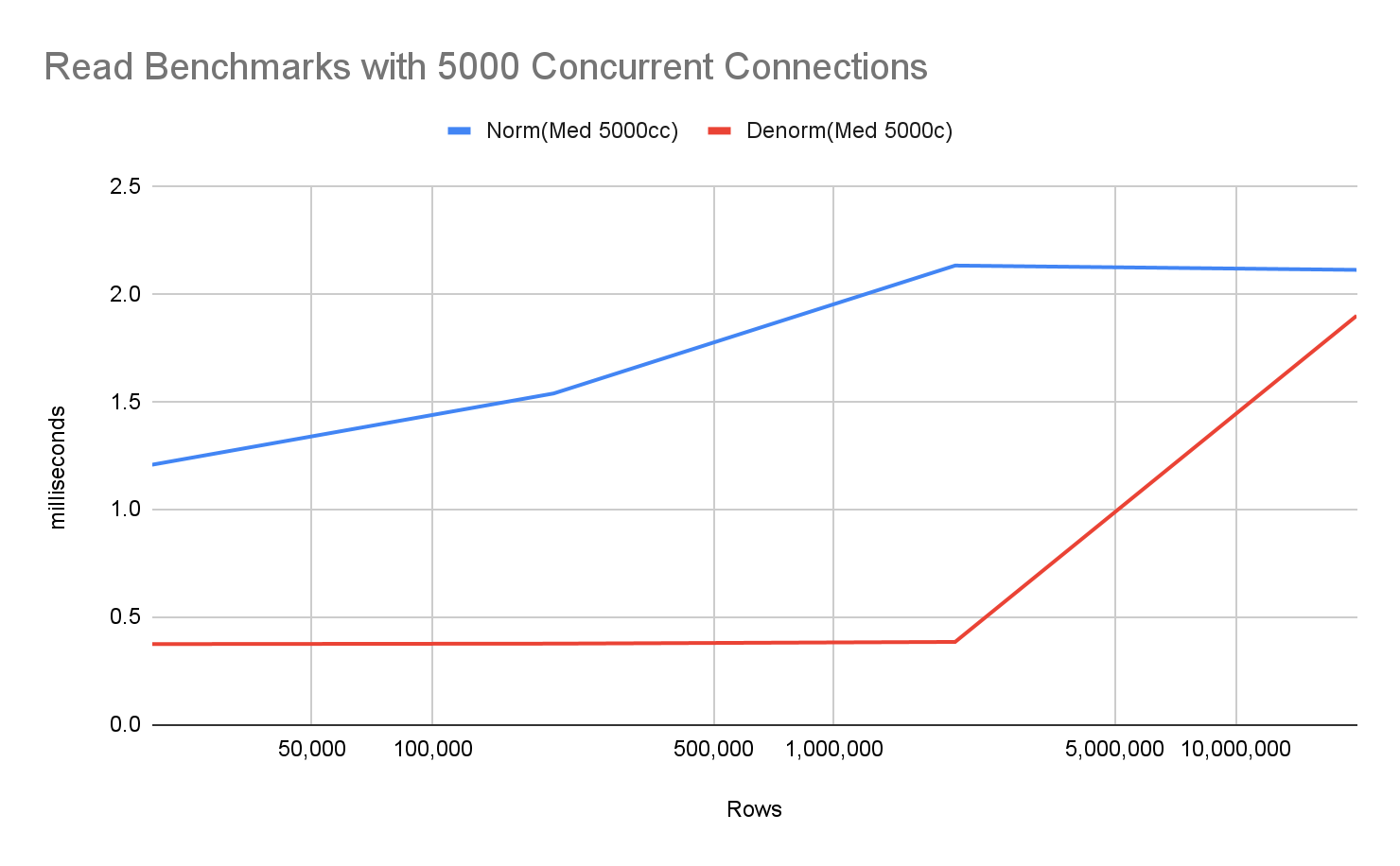
For a smaller dataset representing 2 million users, the read throughput for the denormalized model was 30K/s with sub-millisecond response times. In contrast, the normalized model delivered a throughput of 12K/s with response times under 2ms. However, once the database size exceeds the server’s available RAM, the advantage of a normalized data structure becomes self-evident. 

For 20 million users, the size of the denormalized data exceeded the available RAM. This resulted in a throughput drop to 9K/s and 3-4ms response times. The normalized data’s throughput—being far smaller on disk—remained steady at 12K/s, with response times increasing only slightly to just over 2ms.

For 200 million users, the size of the normalized data also exceeded the available RAM. Throughput dropped only slightly to 9K/s, with median response times increasing only slightly to 2.6ms. 

We could not test 200 million denormalized records, as loading that much data on disk would have taken far too long. Another advantage of the normalized data structure is writing performance, with write throughput remaining consistently 12 times higher than for denormalized (13,000 records/second vs 1,100 records/second). 

Methodology and Hardware Specs

Benchmark testing was performed against Harper 4.0.0 running on a Linode VM in the Atlanta, GA region.  

Hardware:

50 CPU Cores - AMD EPYC 7642

128GB RAM

2,500 GB Storage, ext4 

Ubuntu 22.04

Tests were executed against User record sets of 20K, 200K, 2MM, 20MM, and 200MM, where each User has 150 associated entitlements. For each increment of record sets, we ran tests to show performance as we increased the number of concurrent connections (cc) which scaled as follows: 1cc, 50cc, 500cc, 1000cc, and 5000cc. The goal of scaling concurrent connections was to demonstrate not just optimistic performance with a single API call, but to show how Harper performs as we scale concurrent requests against both the normalized and denormalized data sets.

For each increment in the size of data sets, new data was loaded into Harper tables. Data was loaded with sequential primary key values to optimize data ingest performance.

Every test iteration was executed to compare the performance of normalized data sets versus denormalized data sets. The load was applied to Harper via another dedicated server, with equal specs, in the Atlanta, GA region running k6, an open-source, high-scale load testing tool. Harper was running with the HTTP protocol, and we were executing the requests with Keep-Alive enabled. Tests were executed for 300 seconds, where we recorded summary statistics for each test run and data for every request performed. All times reported in this document are the time it took Harper to process requests, recorded via the Harper server-timing header, and not the total response time of a request, which would include variable Internet latency. 

Harper Storage Technology

Harper’s storage engine is based on advanced memory mapping technology that enables extremely fast and efficient data access with minimal overhead from system calls, avoiding redundant caching structures and fully leveraging operating system caching capabilities and machine resources. Harper’s storage engine (LMDB) uses a highly optimized B-tree structure for fast O(log n) data access. This is combined with an extremely tight in-process path from storage to application code (Custom Functions), which enables a high level of flexibility in aggregating data while achieving high-performance results.

By using memory maps, Harper directly uses the operating system disk cache as the database cache. This allows Harper processes to maintain consistent in-memory processing performance while dynamically leveraging the rest of available RAM for database caching to maximize how much data can be effectively cached. This provides efficient memory usage and fast responses for data that is accessed multiple times.

However, as a database size grows beyond the available RAM, there is an inherent need for some database lookups to involve disk reads to fetch data. Precisely estimating the percentage of operations that will require disk reads can be challenging and involves careful analysis of database size and probability distributions of different requests, but generally speaking, as the database grows beyond the size of RAM and to the degree that accessed entitlement are widely distributed, more disk reads will be required.

Normalization Strategy

Traditional relational databases generally have highly normalized data structures and relationships. This can yield very compact and efficient data structures from a storage perspective, accordingly making updates very fast. But, the deep relations and necessary joins are often onerous and preclude high-performance, low-latency access requirements. On the other hand, caching servers often use highly denormalized data, which requires fewer lookups. However, simplistic caching servers can require extreme levels of denormalization that yield very inefficient storage, resulting in poor caching characteristics (since databases can grow well beyond RAM), and extremely slow and cumbersome updates.

In this prototype, we are pursuing the strategy of a “balanced” normalization. There are often natural relations in the data that can be flattened and denormalized. Selective denormalization of data that is always user or entitlement-specific eliminates deeper levels of relations and joins for fast access. However, we believe there is also a significant benefit in maintaining the normalization of entitlement as a separate table from users since user accounts often reference hundreds of entitlements. By maintaining this normalization, storing users and records can be very efficient. Consequently, entitlements that correspond to multiple users can quickly and easily be updated, storage requirements are dramatically reduced, and with the large scale of data required, a much higher percentage of data can be maintained in memory caches for faster access. With Harper’s flexible data schemas and model, in combination with the ability to write customized aggregation queries to join data in Custom Functions, Harper facilitates this “balanced” normalization approach.

To test this prototype, we have benchmarked normalization (of users and entitlement as separate tables) versus a full denormalized data model with increasing database size. Before benchmarking, our hypothesis was that a denormalized data model would be fastest with smaller databases that fit in memory since each request essentially involves a single B-tree lookup. But, as the database grows in size, we expect the normalized database to be much more compact. As the database exceeds the size of available RAM, we expect to maintain a higher percentage of cache hits and, therefore, a better scaling of performance with the normalized data model. The more efficient data storage model of the normalized data will result in much faster write/update performance and reduced storage requirements and cost.

Results

For smaller databases (2 million users and fewer), benchmarks of denormalized and normalized both yield extremely fast response times, but as expected, the denormalized model is fastest with nearly instantaneous, sub-millisecond responses. The throughput of the denormalized model (on a single server) is roughly 30K/s, whereas the normalized model is about 12K/s.

However, as the database grows to larger sizes (20 million users), the benchmarks distinctly shift, as hypothesized. At this size, the denormalized database is about twice the size of available RAM, and a significant percentage of the requests require disk reads, dropping throughput down to about 9K/s with 3-4 millisecond access time under load. On the other hand, the normalized database is significantly smaller than the denormalized database and continues to easily fit in RAM. This is demonstrated as the throughput is almost unchanged at this scale, still maintaining 12K/s and 2-3 millisecond access times.

In the full production scenario, we would anticipate that even the normalized database may exceed available RAM, but with realistic distributions of data accesses, the vast majority of requests could be accessible through in-memory cached data. With full large-scale handling of the entire user database, this normalized data model approach appears to strike a balanced approach to fast data access with minimal data fetches while maintaining the necessary normalization for efficient storage and updates.
Performance Metrics

Write Performance and Size on Disk

  • On average, normalized data has 12.12 times more throughput on write than denormalized. 
  • On average, denormalized data is 13.1 times larger than normalized data on disk. 
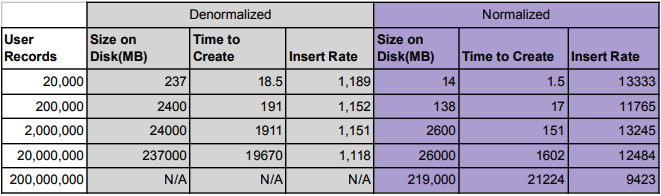
We project that: 200MM rows would take 50 hours to insert denormalized and would take up 2.5TB on disk. 

As can be seen from the above table, loading denormalized data takes significantly longer than normalized. Another drawback to a denormalized data approach is the footprint on disk is significantly higher. Maintaining a normalized data set will be significantly more performant as only the referenced entitlement would need to be updated instead of a denormalized data set where all users would need to be modified, requiring many more writes to the system.

Read Performance

For additional graphs and detailed results, please download the full report.

Data Model Overview 

Normalized Data

Normalized data is organized into tables, each representing a specific type of information. This structure divides data into logical groups to minimize redundancy and ensure consistency. Relationships between tables are established through keys, allowing for efficient data retrieval and updating. Normalized data models help ensure data integrity and reduce the risk of errors or inconsistencies in the data.

Denormalized Data

Denormalized data combines multiple types of data into a single table. This can result in data duplication and a larger table size. Accordingly, it consumes more of a database's in-memory cache. It can also increase the risk of inconsistencies in the data and make updates more resource-intensive since data needs to be updated in multiple locations. Historically, the upside to denormalization is lookup speed because the system just needs to perform one look-up rather than multiple. 

Summary of Results

  • Normalized data’s performance scales significantly better.
  • Denormalized data’s speed advantage drops off when the size on disk exceeds system RAM.
  • On average, normalized data has 12.12 times more throughput on write than denormalized. 
  • On average, denormalized data is 13.1 times larger than normalized data on disk.  

Performance was compared for normalized and denormalized data models. Multiple tests were run against datasets of increasing size and with increasing user concurrency on a single server. 

Datasets were intended to simulate various user counts, starting with 20,000 users and increasing by an order of magnitude for each test, with a final simulation of 200,000,000 users. Each user has 150 entitlements that represent purchases of various digital items. Entitlements were stored as part of the user’s record when testing the denormalized data model and as a separate table while testing normalized data. 

Entitlements were randomly selected from a pool of entitlements that varied in size based on the user base. The number of entitlements was 10% of the number of users. For example, when testing 20 million users, a list of 2 million potential entitlements was created, then each user was associated with 150 of those entitlements.

For a smaller dataset representing 2 million users, the read throughput for the denormalized model was 30K/s with sub-millisecond response times. In contrast, the normalized model delivered a throughput of 12K/s with response times under 2ms. However, once the database size exceeds the server’s available RAM, the advantage of a normalized data structure becomes self-evident. 

For 20 million users, the size of the denormalized data exceeded the available RAM. This resulted in a throughput drop to 9K/s and 3-4ms response times. The normalized data’s throughput—being far smaller on disk—remained steady at 12K/s, with response times increasing only slightly to just over 2ms.

For 200 million users, the size of the normalized data also exceeded the available RAM. Throughput dropped only slightly to 9K/s, with median response times increasing only slightly to 2.6ms. 

We could not test 200 million denormalized records, as loading that much data on disk would have taken far too long. Another advantage of the normalized data structure is writing performance, with write throughput remaining consistently 12 times higher than for denormalized (13,000 records/second vs 1,100 records/second). 

Methodology and Hardware Specs

Benchmark testing was performed against Harper 4.0.0 running on a Linode VM in the Atlanta, GA region.  

Hardware:

50 CPU Cores - AMD EPYC 7642

128GB RAM

2,500 GB Storage, ext4 

Ubuntu 22.04

Tests were executed against User record sets of 20K, 200K, 2MM, 20MM, and 200MM, where each User has 150 associated entitlements. For each increment of record sets, we ran tests to show performance as we increased the number of concurrent connections (cc) which scaled as follows: 1cc, 50cc, 500cc, 1000cc, and 5000cc. The goal of scaling concurrent connections was to demonstrate not just optimistic performance with a single API call, but to show how Harper performs as we scale concurrent requests against both the normalized and denormalized data sets.

For each increment in the size of data sets, new data was loaded into Harper tables. Data was loaded with sequential primary key values to optimize data ingest performance.

Every test iteration was executed to compare the performance of normalized data sets versus denormalized data sets. The load was applied to Harper via another dedicated server, with equal specs, in the Atlanta, GA region running k6, an open-source, high-scale load testing tool. Harper was running with the HTTP protocol, and we were executing the requests with Keep-Alive enabled. Tests were executed for 300 seconds, where we recorded summary statistics for each test run and data for every request performed. All times reported in this document are the time it took Harper to process requests, recorded via the Harper server-timing header, and not the total response time of a request, which would include variable Internet latency. 

Harper Storage Technology

Harper’s storage engine is based on advanced memory mapping technology that enables extremely fast and efficient data access with minimal overhead from system calls, avoiding redundant caching structures and fully leveraging operating system caching capabilities and machine resources. Harper’s storage engine (LMDB) uses a highly optimized B-tree structure for fast O(log n) data access. This is combined with an extremely tight in-process path from storage to application code (Custom Functions), which enables a high level of flexibility in aggregating data while achieving high-performance results.

By using memory maps, Harper directly uses the operating system disk cache as the database cache. This allows Harper processes to maintain consistent in-memory processing performance while dynamically leveraging the rest of available RAM for database caching to maximize how much data can be effectively cached. This provides efficient memory usage and fast responses for data that is accessed multiple times.

However, as a database size grows beyond the available RAM, there is an inherent need for some database lookups to involve disk reads to fetch data. Precisely estimating the percentage of operations that will require disk reads can be challenging and involves careful analysis of database size and probability distributions of different requests, but generally speaking, as the database grows beyond the size of RAM and to the degree that accessed entitlement are widely distributed, more disk reads will be required.

Normalization Strategy

Traditional relational databases generally have highly normalized data structures and relationships. This can yield very compact and efficient data structures from a storage perspective, accordingly making updates very fast. But, the deep relations and necessary joins are often onerous and preclude high-performance, low-latency access requirements. On the other hand, caching servers often use highly denormalized data, which requires fewer lookups. However, simplistic caching servers can require extreme levels of denormalization that yield very inefficient storage, resulting in poor caching characteristics (since databases can grow well beyond RAM), and extremely slow and cumbersome updates.

In this prototype, we are pursuing the strategy of a “balanced” normalization. There are often natural relations in the data that can be flattened and denormalized. Selective denormalization of data that is always user or entitlement-specific eliminates deeper levels of relations and joins for fast access. However, we believe there is also a significant benefit in maintaining the normalization of entitlement as a separate table from users since user accounts often reference hundreds of entitlements. By maintaining this normalization, storing users and records can be very efficient. Consequently, entitlements that correspond to multiple users can quickly and easily be updated, storage requirements are dramatically reduced, and with the large scale of data required, a much higher percentage of data can be maintained in memory caches for faster access. With Harper’s flexible data schemas and model, in combination with the ability to write customized aggregation queries to join data in Custom Functions, Harper facilitates this “balanced” normalization approach.

To test this prototype, we have benchmarked normalization (of users and entitlement as separate tables) versus a full denormalized data model with increasing database size. Before benchmarking, our hypothesis was that a denormalized data model would be fastest with smaller databases that fit in memory since each request essentially involves a single B-tree lookup. But, as the database grows in size, we expect the normalized database to be much more compact. As the database exceeds the size of available RAM, we expect to maintain a higher percentage of cache hits and, therefore, a better scaling of performance with the normalized data model. The more efficient data storage model of the normalized data will result in much faster write/update performance and reduced storage requirements and cost.

Results

For smaller databases (2 million users and fewer), benchmarks of denormalized and normalized both yield extremely fast response times, but as expected, the denormalized model is fastest with nearly instantaneous, sub-millisecond responses. The throughput of the denormalized model (on a single server) is roughly 30K/s, whereas the normalized model is about 12K/s.

However, as the database grows to larger sizes (20 million users), the benchmarks distinctly shift, as hypothesized. At this size, the denormalized database is about twice the size of available RAM, and a significant percentage of the requests require disk reads, dropping throughput down to about 9K/s with 3-4 millisecond access time under load. On the other hand, the normalized database is significantly smaller than the denormalized database and continues to easily fit in RAM. This is demonstrated as the throughput is almost unchanged at this scale, still maintaining 12K/s and 2-3 millisecond access times.

In the full production scenario, we would anticipate that even the normalized database may exceed available RAM, but with realistic distributions of data accesses, the vast majority of requests could be accessible through in-memory cached data. With full large-scale handling of the entire user database, this normalized data model approach appears to strike a balanced approach to fast data access with minimal data fetches while maintaining the necessary normalization for efficient storage and updates.

Performance Metrics

Write Performance and Size on Disk

  • On average, normalized data has 12.12 times more throughput on write than denormalized. 
  • On average, denormalized data is 13.1 times larger than normalized data on disk. 

We project that: 200MM rows would take 50 hours to insert denormalized and would take up 2.5TB on disk. 

As can be seen from the above table, loading denormalized data takes significantly longer than normalized. Another drawback to a denormalized data approach is the footprint on disk is significantly higher. Maintaining a normalized data set will be significantly more performant as only the referenced entitlement would need to be updated instead of a denormalized data set where all users would need to be modified, requiring many more writes to the system.

Read Performance

For additional graphs and detailed results, please download the full report.

Harper enables normalized data to be a practical storage solution with minimal impact on read performance.

Download

White arrow pointing right
Harper enables normalized data to be a practical storage solution with minimal impact on read performance.

Download

White arrow pointing right
Harper enables normalized data to be a practical storage solution with minimal impact on read performance.

Download

White arrow pointing right

Explore Recent Resources

Livestream
GitHub Logo

2 Hour Build - Live Stream for Non-Developers

A non-developer's live stream walkthrough of building Flow State, a Colorado river-flow app for rafters, in two hours using ChatGPT dictation, Claude Code, Claude Design, and Harper. Scaffold with npm create harper@latest and deploy to Harper Fabric. No coding background required.
Livestream
A non-developer's live stream walkthrough of building Flow State, a Colorado river-flow app for rafters, in two hours using ChatGPT dictation, Claude Code, Claude Design, and Harper. Scaffold with npm create harper@latest and deploy to Harper Fabric. No coding background required.
Person with short dark hair and moustache, wearing a colorful plaid shirt, smiling outdoors in a forested mountain landscape.
Aleks Haugom
Senior Manager of GTM
Livestream

2 Hour Build - Live Stream for Non-Developers

A non-developer's live stream walkthrough of building Flow State, a Colorado river-flow app for rafters, in two hours using ChatGPT dictation, Claude Code, Claude Design, and Harper. Scaffold with npm create harper@latest and deploy to Harper Fabric. No coding background required.
Aleks Haugom
May 2026
Livestream

2 Hour Build - Live Stream for Non-Developers

A non-developer's live stream walkthrough of building Flow State, a Colorado river-flow app for rafters, in two hours using ChatGPT dictation, Claude Code, Claude Design, and Harper. Scaffold with npm create harper@latest and deploy to Harper Fabric. No coding background required.
Aleks Haugom
Livestream

2 Hour Build - Live Stream for Non-Developers

A non-developer's live stream walkthrough of building Flow State, a Colorado river-flow app for rafters, in two hours using ChatGPT dictation, Claude Code, Claude Design, and Harper. Scaffold with npm create harper@latest and deploy to Harper Fabric. No coding background required.
Aleks Haugom
Tutorial
GitHub Logo

Production Quality at Vibe Code Velocity: Dispatched Agent Teams with Harper

Harper enables production-grade agentic engineering by collapsing database, cache, runtime, and messaging into one process, reducing agent complexity and review burden. A multi-model dispatch workflow lets specialized agents plan, code, QA, and review in parallel while humans retain control over critical decisions.
Tutorial
Harper enables production-grade agentic engineering by collapsing database, cache, runtime, and messaging into one process, reducing agent complexity and review burden. A multi-model dispatch workflow lets specialized agents plan, code, QA, and review in parallel while humans retain control over critical decisions.
Person with very short hair and a goatee wearing a plaid button‑up shirt over a white undershirt, smiling outdoors with leafy greenery behind.
Jeff Darnton
SVP, Professional Services & Customer Success
Tutorial

Production Quality at Vibe Code Velocity: Dispatched Agent Teams with Harper

Harper enables production-grade agentic engineering by collapsing database, cache, runtime, and messaging into one process, reducing agent complexity and review burden. A multi-model dispatch workflow lets specialized agents plan, code, QA, and review in parallel while humans retain control over critical decisions.
Jeff Darnton
May 2026
Tutorial

Production Quality at Vibe Code Velocity: Dispatched Agent Teams with Harper

Harper enables production-grade agentic engineering by collapsing database, cache, runtime, and messaging into one process, reducing agent complexity and review burden. A multi-model dispatch workflow lets specialized agents plan, code, QA, and review in parallel while humans retain control over critical decisions.
Jeff Darnton
Tutorial

Production Quality at Vibe Code Velocity: Dispatched Agent Teams with Harper

Harper enables production-grade agentic engineering by collapsing database, cache, runtime, and messaging into one process, reducing agent complexity and review burden. A multi-model dispatch workflow lets specialized agents plan, code, QA, and review in parallel while humans retain control over critical decisions.
Jeff Darnton
Tutorial
GitHub Logo

Change Data Capture Into a Runtime: One Pipeline for Pages, Search, and AI Agents

Learn how Harper turns CDC streams into real-time workflows that refresh cached pages, update search indexes, and keep AI agent context current. See why landing changes in an application runtime beats warehouses, queues, and traditional CDNs.
Tutorial
Learn how Harper turns CDC streams into real-time workflows that refresh cached pages, update search indexes, and keep AI agent context current. See why landing changes in an application runtime beats warehouses, queues, and traditional CDNs.
Person with very short hair and a goatee wearing a plaid button‑up shirt over a white undershirt, smiling outdoors with leafy greenery behind.
Jeff Darnton
SVP, Professional Services & Customer Success
Tutorial

Change Data Capture Into a Runtime: One Pipeline for Pages, Search, and AI Agents

Learn how Harper turns CDC streams into real-time workflows that refresh cached pages, update search indexes, and keep AI agent context current. See why landing changes in an application runtime beats warehouses, queues, and traditional CDNs.
Jeff Darnton
May 2026
Tutorial

Change Data Capture Into a Runtime: One Pipeline for Pages, Search, and AI Agents

Learn how Harper turns CDC streams into real-time workflows that refresh cached pages, update search indexes, and keep AI agent context current. See why landing changes in an application runtime beats warehouses, queues, and traditional CDNs.
Jeff Darnton
Tutorial

Change Data Capture Into a Runtime: One Pipeline for Pages, Search, and AI Agents

Learn how Harper turns CDC streams into real-time workflows that refresh cached pages, update search indexes, and keep AI agent context current. See why landing changes in an application runtime beats warehouses, queues, and traditional CDNs.
Jeff Darnton
Tutorial
GitHub Logo

Harper + Vertex AI: The Architecture Every Agent Builder Should Know

Production agents bleed tokens and latency on repeated queries. Pair a managed model layer with a vector-indexed data layer at the edge, and an 80% cache hit rate cuts LLM spend by 80% while delivering sub-100ms responses on semantically similar requests.
Tutorial
Production agents bleed tokens and latency on repeated queries. Pair a managed model layer with a vector-indexed data layer at the edge, and an 80% cache hit rate cuts LLM spend by 80% while delivering sub-100ms responses on semantically similar requests.
Person with styled reddish‑brown hair and a full beard wearing a gray suit with a light blue shirt and dark green tie, posing outdoors with a blurred pathway and greenery behind.
Drew Chambers
CMO
Tutorial

Harper + Vertex AI: The Architecture Every Agent Builder Should Know

Production agents bleed tokens and latency on repeated queries. Pair a managed model layer with a vector-indexed data layer at the edge, and an 80% cache hit rate cuts LLM spend by 80% while delivering sub-100ms responses on semantically similar requests.
Drew Chambers
May 2026
Tutorial

Harper + Vertex AI: The Architecture Every Agent Builder Should Know

Production agents bleed tokens and latency on repeated queries. Pair a managed model layer with a vector-indexed data layer at the edge, and an 80% cache hit rate cuts LLM spend by 80% while delivering sub-100ms responses on semantically similar requests.
Drew Chambers
Tutorial

Harper + Vertex AI: The Architecture Every Agent Builder Should Know

Production agents bleed tokens and latency on repeated queries. Pair a managed model layer with a vector-indexed data layer at the edge, and an 80% cache hit rate cuts LLM spend by 80% while delivering sub-100ms responses on semantically similar requests.
Drew Chambers
Blog
GitHub Logo

Why Harper is the Definitive Platform for Enterprise Citizen Developers

Harper bridges the gap between business agility and IT security. Utilizing a unified runtime, Harper Fabric guarantees data sovereignty across any environment, from public clouds to air-gapped facilities. Empower users with secure, compliant AI application development and robust governance.
Blog
Harper bridges the gap between business agility and IT security. Utilizing a unified runtime, Harper Fabric guarantees data sovereignty across any environment, from public clouds to air-gapped facilities. Empower users with secure, compliant AI application development and robust governance.
A smiling man with a beard and salt-and-pepper hair stands outdoors with arms crossed, wearing a white button-down shirt.
Stephen Goldberg
CEO & Co-Founder
Blog

Why Harper is the Definitive Platform for Enterprise Citizen Developers

Harper bridges the gap between business agility and IT security. Utilizing a unified runtime, Harper Fabric guarantees data sovereignty across any environment, from public clouds to air-gapped facilities. Empower users with secure, compliant AI application development and robust governance.
Stephen Goldberg
May 2026
Blog

Why Harper is the Definitive Platform for Enterprise Citizen Developers

Harper bridges the gap between business agility and IT security. Utilizing a unified runtime, Harper Fabric guarantees data sovereignty across any environment, from public clouds to air-gapped facilities. Empower users with secure, compliant AI application development and robust governance.
Stephen Goldberg
Blog

Why Harper is the Definitive Platform for Enterprise Citizen Developers

Harper bridges the gap between business agility and IT security. Utilizing a unified runtime, Harper Fabric guarantees data sovereignty across any environment, from public clouds to air-gapped facilities. Empower users with secure, compliant AI application development and robust governance.
Stephen Goldberg
Comparison
GitHub Logo

Harper vs. Vercel + Supabase

Harper offers a unified application platform alternative to Vercel + Supabase, combining database, cache, app logic, messaging, vectors, and real-time capabilities in one globally distributed runtime to reduce latency, operational complexity, and total cost of ownership.
Comparison
Harper offers a unified application platform alternative to Vercel + Supabase, combining database, cache, app logic, messaging, vectors, and real-time capabilities in one globally distributed runtime to reduce latency, operational complexity, and total cost of ownership.
Colorful geometric illustration of a dog's head resembling folded paper art in shades of teal and pink.
Harper
Comparison

Harper vs. Vercel + Supabase

Harper offers a unified application platform alternative to Vercel + Supabase, combining database, cache, app logic, messaging, vectors, and real-time capabilities in one globally distributed runtime to reduce latency, operational complexity, and total cost of ownership.
Harper
May 2026
Comparison

Harper vs. Vercel + Supabase

Harper offers a unified application platform alternative to Vercel + Supabase, combining database, cache, app logic, messaging, vectors, and real-time capabilities in one globally distributed runtime to reduce latency, operational complexity, and total cost of ownership.
Harper
Comparison

Harper vs. Vercel + Supabase

Harper offers a unified application platform alternative to Vercel + Supabase, combining database, cache, app logic, messaging, vectors, and real-time capabilities in one globally distributed runtime to reduce latency, operational complexity, and total cost of ownership.
Harper