



Click Below to Get the Code

Browse, clone, and build from real-world templates powered by Harper.
Solution
GitHub Logo

GraphQL

Harper revolutionizes GraphQL performance by fusing database, cache, application logic, and messaging into a single edge-native runtime—eliminating CDN cache misses, reducing backend strain, and slashing latency. With features like whole and partial query caching, real-time data freshness via CDC, and an incremental adoption path, Harper enables fast, scalable, and simplified GraphQL delivery without major rewrites.
GraphQL
Solution
GraphQL

GraphQL

By
Harper
June 12, 2025
By
Harper
June 12, 2025
By
Harper
June 12, 2025
June 12, 2025
Harper revolutionizes GraphQL performance by fusing database, cache, application logic, and messaging into a single edge-native runtime—eliminating CDN cache misses, reducing backend strain, and slashing latency. With features like whole and partial query caching, real-time data freshness via CDC, and an incremental adoption path, Harper enables fast, scalable, and simplified GraphQL delivery without major rewrites.
Harper

GraphQL streamlines data access, but its dynamic, payload-based requests break traditional CDN caching, resulting in latency, increased costs, and backend strain. Harper solves this with a fused, edge-native runtime that combines database, cache, application logic, and messaging functions into a single process. By resolving queries closer to users with cached data, Harper reduces egress and boosts performance. And with an incremental adoption path—from full-query caching to field-level routing—teams can see immediate gains without major rewrites.

Challenges with Common GraphQL Deployments

  • Caching Breaks: GraphQL’s POST-based, single-endpoint architecture bypasses traditional path and header-based CDN caching, often resulting in zero cache hits.
  • Latency Stacks: Each field in a resolver chain may trigger separate cross-network calls, thereby delaying time-to-first-byte (TTFB) and negatively impacting Core Web Vitals.
  • Origins Strain: Without a caching layer, every query hits backend databases or microservices directly, driving up compute costs, database load, and operational strain.
  • Freshness Lags: Most GraphQL caching solutions lack native Change Data Capture (CDC) or event streaming capabilities, making it challenging to keep data fresh without relying on expensive polling or brittle revalidation workarounds.

Why Harper Is Built for Modern GraphQL

Most GraphQL platforms leave teams juggling too many moving parts—external databases, distributed caches, middleware, polling infrastructure—just to make a single query fast and fresh. Harper changes that by fusing the pieces together and bringing them to the edge.

Deployed at the edge near every user, Harper’s fused runtime streamlines query resolution with one lightweight process. This architecture eliminates the traditional tradeoffs between speed, scale, and simplicity.


GraphQL Request Lifecycle with Harper: From Frontend Query to Fused Stack Response

Getting Started Is Easy

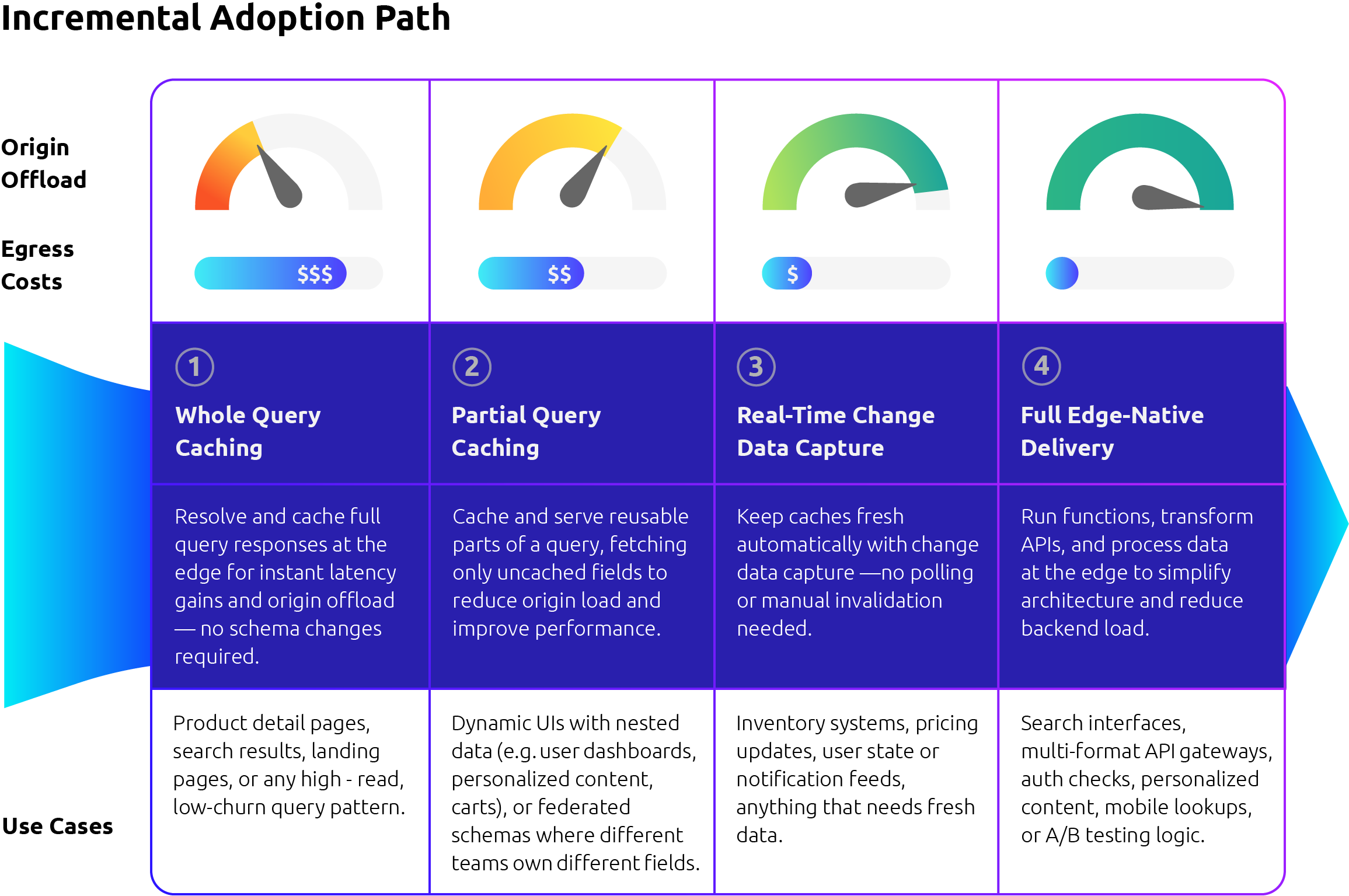
Whether you're looking to reduce origin traffic, accelerate personalized UIs, or simplify GraphQL operations at scale, Harper meets you where you are. Start with whole-query caching for instant gains, or move straight into field-level control, real-time updates, and edge-native logic. 

Harper can replace your existing GraphQL resolver, allowing you to maintain your current API contract while gaining performance and flexibility from the start. It’s a lightweight switch with minimal impact on clients and a clear path to deeper optimization over time.

Start small. Scale fast. Modernize GraphQL without disrupting your users.

GraphQL streamlines data access, but its dynamic, payload-based requests break traditional CDN caching, resulting in latency, increased costs, and backend strain. Harper solves this with a fused, edge-native runtime that combines database, cache, application logic, and messaging functions into a single process. By resolving queries closer to users with cached data, Harper reduces egress and boosts performance. And with an incremental adoption path—from full-query caching to field-level routing—teams can see immediate gains without major rewrites.

Challenges with Common GraphQL Deployments

  • Caching Breaks: GraphQL’s POST-based, single-endpoint architecture bypasses traditional path and header-based CDN caching, often resulting in zero cache hits.
  • Latency Stacks: Each field in a resolver chain may trigger separate cross-network calls, thereby delaying time-to-first-byte (TTFB) and negatively impacting Core Web Vitals.
  • Origins Strain: Without a caching layer, every query hits backend databases or microservices directly, driving up compute costs, database load, and operational strain.
  • Freshness Lags: Most GraphQL caching solutions lack native Change Data Capture (CDC) or event streaming capabilities, making it challenging to keep data fresh without relying on expensive polling or brittle revalidation workarounds.

Why Harper Is Built for Modern GraphQL

Most GraphQL platforms leave teams juggling too many moving parts—external databases, distributed caches, middleware, polling infrastructure—just to make a single query fast and fresh. Harper changes that by fusing the pieces together and bringing them to the edge.

Deployed at the edge near every user, Harper’s fused runtime streamlines query resolution with one lightweight process. This architecture eliminates the traditional tradeoffs between speed, scale, and simplicity.


GraphQL Request Lifecycle with Harper: From Frontend Query to Fused Stack Response

Getting Started Is Easy

Whether you're looking to reduce origin traffic, accelerate personalized UIs, or simplify GraphQL operations at scale, Harper meets you where you are. Start with whole-query caching for instant gains, or move straight into field-level control, real-time updates, and edge-native logic. 

Harper can replace your existing GraphQL resolver, allowing you to maintain your current API contract while gaining performance and flexibility from the start. It’s a lightweight switch with minimal impact on clients and a clear path to deeper optimization over time.

Start small. Scale fast. Modernize GraphQL without disrupting your users.

Harper revolutionizes GraphQL performance by fusing database, cache, application logic, and messaging into a single edge-native runtime—eliminating CDN cache misses, reducing backend strain, and slashing latency. With features like whole and partial query caching, real-time data freshness via CDC, and an incremental adoption path, Harper enables fast, scalable, and simplified GraphQL delivery without major rewrites.

Download

White arrow pointing right
Harper revolutionizes GraphQL performance by fusing database, cache, application logic, and messaging into a single edge-native runtime—eliminating CDN cache misses, reducing backend strain, and slashing latency. With features like whole and partial query caching, real-time data freshness via CDC, and an incremental adoption path, Harper enables fast, scalable, and simplified GraphQL delivery without major rewrites.

Download

White arrow pointing right
Harper revolutionizes GraphQL performance by fusing database, cache, application logic, and messaging into a single edge-native runtime—eliminating CDN cache misses, reducing backend strain, and slashing latency. With features like whole and partial query caching, real-time data freshness via CDC, and an incremental adoption path, Harper enables fast, scalable, and simplified GraphQL delivery without major rewrites.

Download

White arrow pointing right

Explore Recent Resources