




Keep your commerce platform. Connect the systems behind the experience.
You’ve invested in Salesforce Commerce Cloud to run your business: merchandising, pricing, and transactions. You’ve built teams and processes around it. Your next storefront investment should deliver more value from that foundation.
For complex merchants, the storefront depends on many systems beyond Salesforce Commerce Cloud: inventory, content, reviews, and internal services. A modern frontend still has to bring their information together before shoppers can buy.
That gap shows up in familiar business pressures:
Shoppers are still waiting. The page appears quickly, but availability, reviews, and other details arrive later, delaying the decision to buy.
Peak traffic and outages put sales at risk. Surges strain backend capacity, while a failure in any connected system can interrupt the experience shoppers need to buy.
New experiences take too long to launch. Every additional system brings connections to build and maintain within your existing delivery and security setup.
AI shopping tools miss part of the story. When crawlers don't receive reviews, those tools lose information about fit, quality, and everyday use.
You can address these pressures while keeping Salesforce Commerce Cloud. Harper connects the systems behind the storefront, runs the logic that brings their information together, and stores information for reuse across visits. It works behind your existing CDN, helping you deliver a richer experience without rebuilding your commerce foundation.

Where Storefront Next fits
Salesforce already offers a native headless option. Storefront Next provides storefront hosting and packaged integrations for services such as payments, tax, and reviews. For merchants whose needs fit that approach, it is a strong starting point.
For retailers with established inventory, content, and internal systems, the decision is whether that native approach can support the full set of systems behind their storefront. The design needs to support fast pages today and make it easier to add the next service or experience.
Storefront Next runs on Managed Runtime, Salesforce’s storefront hosting layer. Managed Runtime supports up to eight proxy configurations per environment: routes that let the storefront reach other systems. Merchants with a broader mix of services may need additional integration work to connect them.
These routes also have practical boundaries. They cannot directly reach systems on a private network, and reusing responses requires caching to be configured.
For merchants with a broader mix of systems, the built-in approach may not be enough. Connecting the storefront to inventory, content, reviews, and internal services is only part of the job. The next step is bringing that information together where pages are built, so every visit doesn’t trigger another round of requests across the business.
Bring the data and the work together
Harper provides an application and integration layer between the storefront and the systems it depends on. Behind your existing CDN, it combines the code that builds pages with a database and built-in caching, so that code can use information stored alongside it.
It can hold selected catalog data, content, reviews, and inventory records, with integrations refreshing them as needed. A product description or review can then serve many visits without another request to its source each time.
Teams get one place to manage storefront logic and connections. Shoppers spend less time waiting for separate systems to supply the same information.
Salesforce Commerce Cloud remains the commerce foundation. Price and availability checks still reach the systems responsible for them to complete a purchase, while Harper handles the information and processing that can be reused.
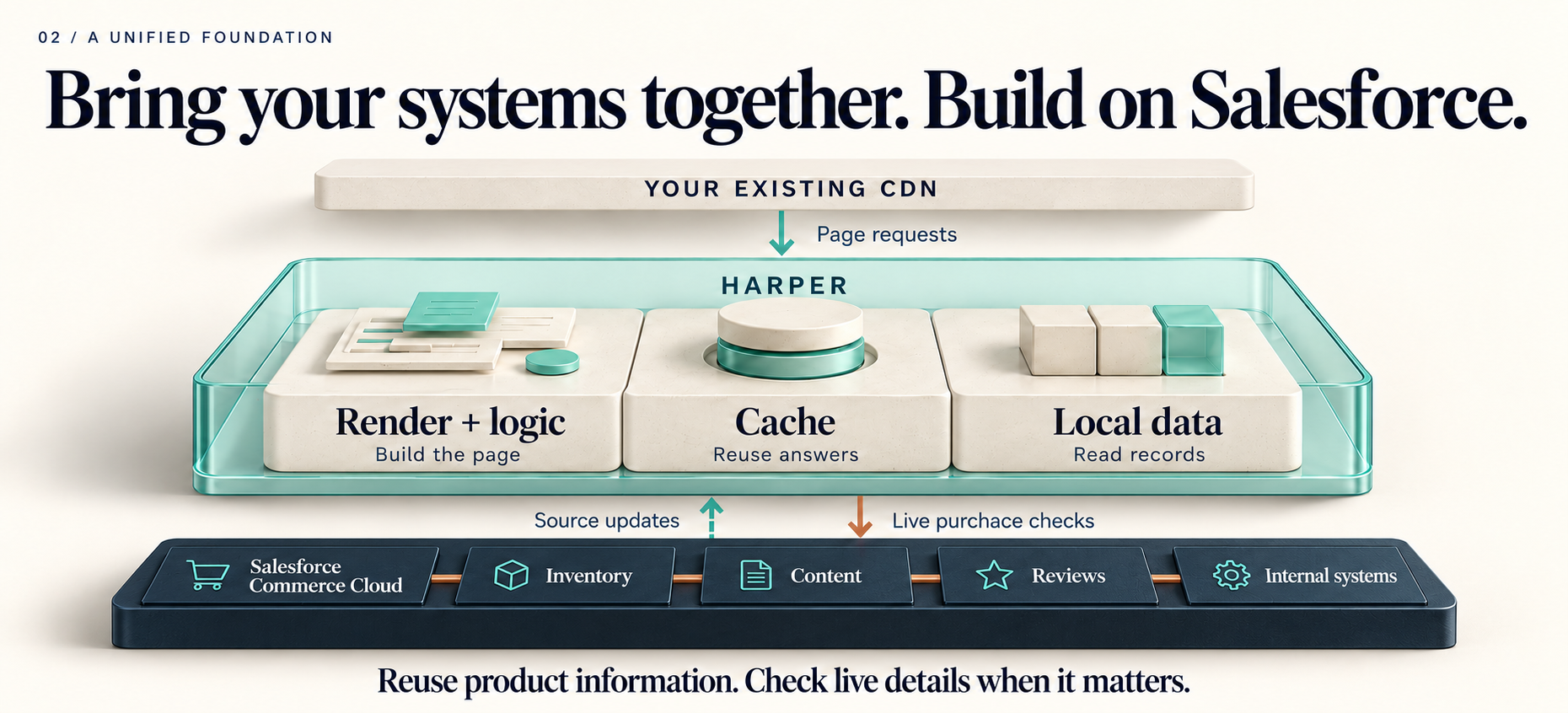
Four ways Harper + SFCC help customers buy more
1. Help shoppers get to a buying decision faster
A shopper choosing a jacket needs more than a photograph. Descriptions, fit guidance, reviews, and editorial content help them decide. Harper keeps this information alongside the code that builds the experience, reducing the need to fetch it from separate services on every visit.
A global luxury fashion brand measured Harper at roughly 2× faster than Vercel, its previous headless host. With roughly 20 systems behind its storefront, the challenge went beyond hosting the frontend: information and application logic needed to work together across the stack.
Harper’s separate, published Vercel benchmark reinforces that performance advantage. It measured 4–14× faster response times for live, personalized workloads, comparing the same application on Harper with a Vercel stack using Neon, Upstash, and Ably. Keeping data and code together removes network trips between services, reducing the time spent waiting for information.
2. Protect the experience during peaks and outages
A peak event brings shoppers, search engines, and AI crawlers to the same storefront. Requests that reuse existing information can still consume backend capacity if they repeatedly reach the source.
Salesforce protects capacity through SCAPI load shedding, returning HTTP 503 responses at the documented threshold after maximum scaling. Checkout endpoints are exempt. OCI availability lookups have a separate quota of 10,000 requests per rolling 10-second window.
Serving reusable information from Harper reduces repeated requests to source systems. Fewer requests mean less data to transfer and less backend work to process, creating opportunities to lower infrastructure costs.
In a 32-day pilot at a major US department store, Harper kept 81.9 million page loads off origin. In the final seven days, Harper handled 82% of crawler traffic without sending it to the origin.
At the measured rate, that's about 306 fewer terabytes of data transferred from origin per year. Serving crawler requests through Harper frees core systems from repeatedly delivering the same pages.
That separation also protects the storefront when a source system goes down. With product information, content, and reviews already held in Harper, browsing can continue using those local copies while the source recovers. The protection can extend across multiple connected systems, reducing the chance that one unavailable service takes the whole experience with it. Purchase steps that require a live response still depend on that service being available.
Harper Fabric adds resilience to Harper itself. Its multi-region clusters replicate data across locations and provide automatic failover, so a regional failure can be handled by healthy regions. Together, local data and regional redundancy help keep the storefront available through disruptions in the systems behind it.
3. Keep your CDN and security investment
Your existing CDN represents more than a delivery contract. It includes security policies, bot controls, routing rules, and years of operational knowledge. Replacing it means added cost, testing, and work for your teams.
Harper works behind that CDN, running storefront logic and storing information that can be reused across visits. Your CDN keeps delivering and protecting the storefront, so you can invest in a better shopping experience without a separate infrastructure migration.
4. Give AI discovery more of the product story
When shoppers ask AI for help choosing a product, part of the buying decision happens before they reach your storefront. That makes the information AI can access commercially important: Adobe found that AI-referred visits to U.S. retail sites had a 90% higher purchase conversion rate than non-AI visits in September 2026.
To reach those shoppers, your product story needs to answer the questions they’re asking. “Does this jacket run small?” requires more than a list of available sizes. Customer reviews can provide the details about fit, quality, and everyday use that help someone choose. But those details only become available to AI discovery tools when they’re included in the content crawlers receive.
Harper brings product details and reviews together in prepared page snapshots, making that information accessible without rebuilding the page for every crawler request. In a department-store pilot, 97.1% of measured AI crawler requests received full pages with reviews after moving to Harper, up from 0% before.
Those richer pages were also faster to serve. Harper delivered the snapshots in 1.7 ms of server-side response time, compared with 437 ms through the origin. Google crawler response time also improved from 570 ms to 240 ms.
The business value is putting the content that helps sell your products within reach of AI-assisted shoppers. Harper helps your investment in product descriptions and customer reviews support discovery beyond the storefront, while keeping repeated crawler requests from adding work to your core systems.
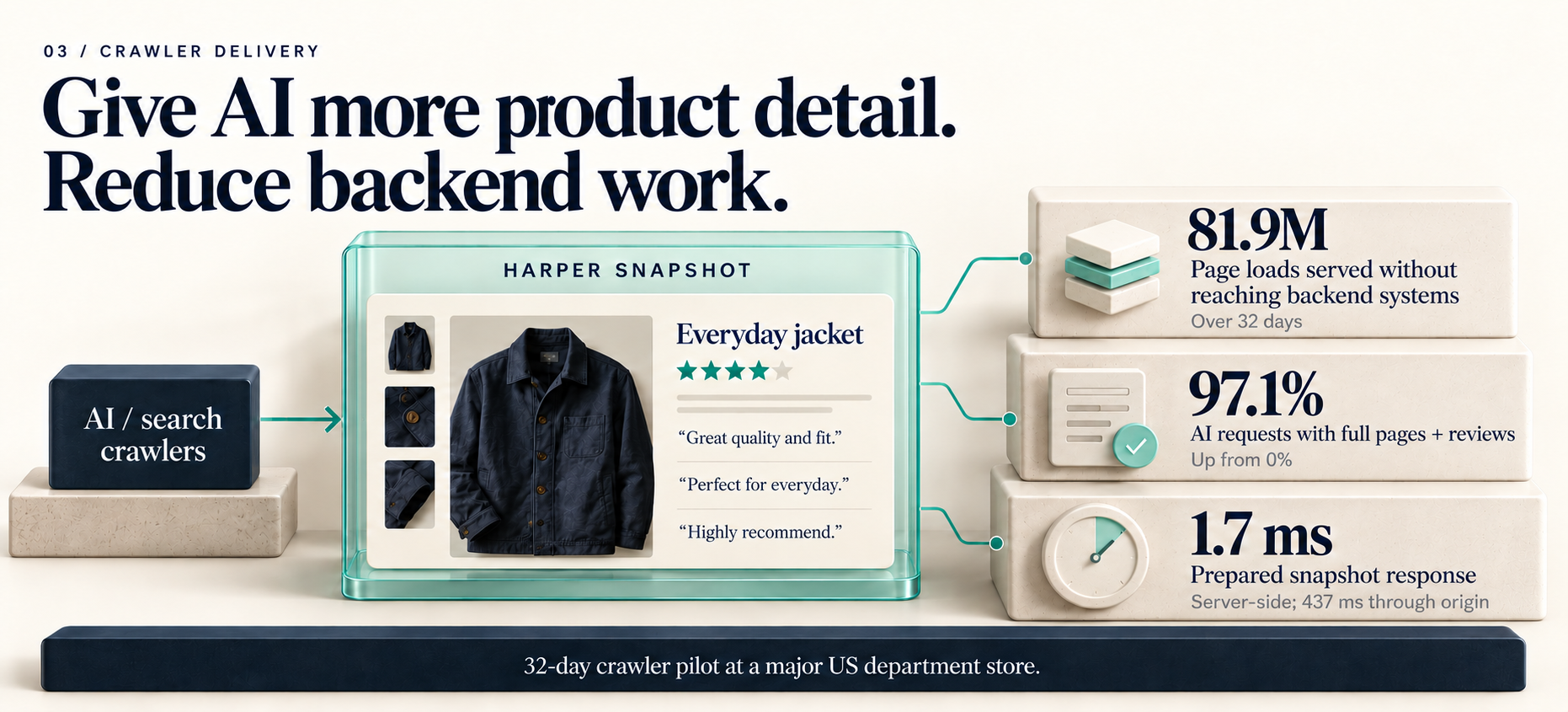
Keep SFCC. Make the wider business work together.
A global luxury fashion brand needed to bring roughly 20 systems together behind one storefront, including SFCC, the brand’s CMS, third-party services, and five internal systems. The priorities were faster page delivery and less time and cost to add new integrations.
The brand had been using Vercel to host its headless storefront and measured Harper at roughly 2× faster. For this environment, the hosting decision centered on bringing information and custom logic together across the wider stack. SFCC remained the commerce foundation.
Harper took on that job. It hosts the brand’s Next.js storefront and supporting application logic, bringing information from those connected systems together in front of SFCC. Its built-in caching lets the storefront reuse that information instead of fetching it repeatedly.
This is the investment story in practice: Salesforce supplies the commerce foundation, CDN handles delivery, and Harper brings the roughly 20 connected systems together for the storefront. Teams gain a place to build new experiences around the systems the business already uses.
Make your existing investment work harder
Your next storefront investment can build on Salesforce Commerce Cloud and the systems around it. Harper adds the connections, application logic, and data reuse that help those investments support a faster, richer experience.
Start with the experience holding you back: a product page that leaves shoppers waiting, an integration delaying a launch, peak traffic straining capacity, outages interrupting browsing, or reviews missing from AI discovery. Connect those needs to the systems behind them, and you have a practical starting point for improvement.
Talk to Harper about the systems behind your storefront and what you want the experience to do next.