



Click Below to Get the Code

Browse, clone, and build from real-world templates powered by Harper.
Solution
GitHub Logo

Dynamic DNS Optimization

Manually configuring DDNS providers is suboptimal. Instead, automate rebalancing with an automated rebalancing service.
Solution

Dynamic DNS Optimization

Harper
at Harper
April 4, 2025
Harper
at Harper
April 4, 2025
Harper
at Harper
April 4, 2025
April 4, 2025
Manually configuring DDNS providers is suboptimal. Instead, automate rebalancing with an automated rebalancing service.
Harper

Suboptimal CDN utilization erodes profitability and hinders user experience. Traditional DNS load balancing methods like round-robin and least-connected fail to account for dynamic network conditions and cost optimization.

Better Experience, Lower Costs

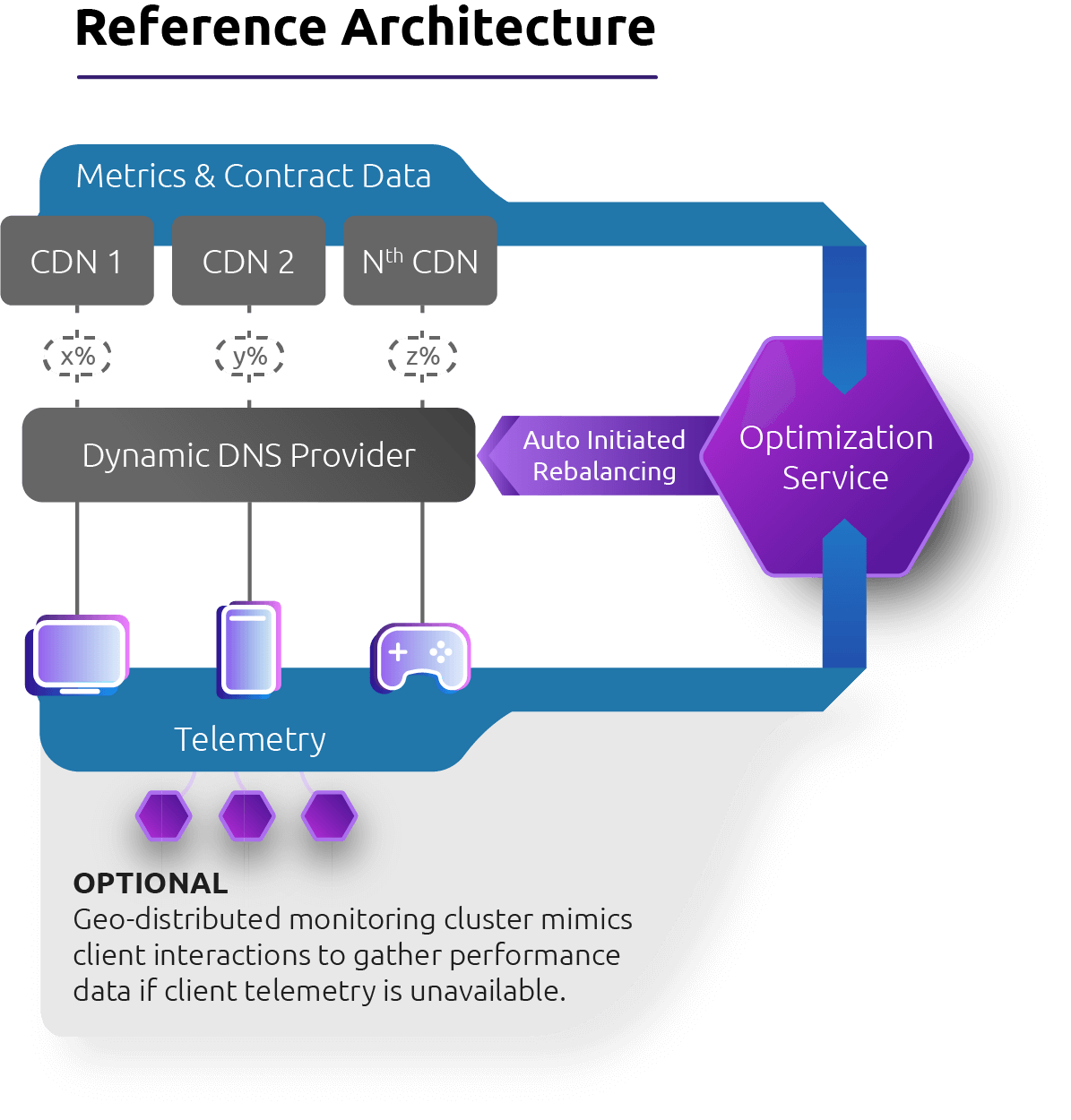
Harper's Dynamic DNS Optimization is a distributed service that makes use of your CDN contract data, current CDN usage, and network performance to optimize traffic distribution across CDNs. By continuously monitoring CDN health, latency, and capacity, our system dynamically adjusts traffic distribution weights to improve user experience, lower costs, and inform CDN renewal commitments.
Add powerful DDNS rebalancing automation to your tech stack.

Getting Started

Ready to optimize your CDN investment and enhance user experience? Contact us to discuss your specific requirements and explore implementation options.


Suboptimal CDN utilization erodes profitability and hinders user experience. Traditional DNS load balancing methods like round-robin and least-connected fail to account for dynamic network conditions and cost optimization.

Better Experience, Lower Costs

Harper's Dynamic DNS Optimization is a distributed service that makes use of your CDN contract data, current CDN usage, and network performance to optimize traffic distribution across CDNs. By continuously monitoring CDN health, latency, and capacity, our system dynamically adjusts traffic distribution weights to improve user experience, lower costs, and inform CDN renewal commitments.

Add powerful DDNS rebalancing automation to your tech stack.

Getting Started

Ready to optimize your CDN investment and enhance user experience? Contact us to discuss your specific requirements and explore implementation options.

Manually configuring DDNS providers is suboptimal. Instead, automate rebalancing with an automated rebalancing service.

Download

White arrow pointing right
Manually configuring DDNS providers is suboptimal. Instead, automate rebalancing with an automated rebalancing service.

Download

White arrow pointing right
Manually configuring DDNS providers is suboptimal. Instead, automate rebalancing with an automated rebalancing service.

Download

White arrow pointing right

Explore Recent Resources

Media Coverage
GitHub Logo

Harper Argues Against the Multi-System Stack and Releases 5.2

InfoQ examines benchmark results comparing co-located and serverless architectures, highlighting faster personalized-data paths, serverless advantages under heavy fan-out, and the performance implications of eliminating network hops between services at scale.
Media Coverage
InfoQ examines benchmark results comparing co-located and serverless architectures, highlighting faster personalized-data paths, serverless advantages under heavy fan-out, and the performance implications of eliminating network hops between services at scale.
Renato Losio, Staff Editor at InfoQ
Renato Losio
InfoQ Staff Editor
Media Coverage

Harper Argues Against the Multi-System Stack and Releases 5.2

InfoQ examines benchmark results comparing co-located and serverless architectures, highlighting faster personalized-data paths, serverless advantages under heavy fan-out, and the performance implications of eliminating network hops between services at scale.
Renato Losio
Aug 2026
Media Coverage

Harper Argues Against the Multi-System Stack and Releases 5.2

InfoQ examines benchmark results comparing co-located and serverless architectures, highlighting faster personalized-data paths, serverless advantages under heavy fan-out, and the performance implications of eliminating network hops between services at scale.
Renato Losio
Media Coverage

Harper Argues Against the Multi-System Stack and Releases 5.2

InfoQ examines benchmark results comparing co-located and serverless architectures, highlighting faster personalized-data paths, serverless advantages under heavy fan-out, and the performance implications of eliminating network hops between services at scale.
Renato Losio
Blog
GitHub Logo

Faster by Doing Less: How Harper 5.2 Engineers Database Performance

Harper 5.2 attacks database performance on three fronts: a per-worker record cache validated through lock-free atomic version slots, isolated commit scheduling to keep database writes off the application thread, and query planner improvements that route through the shortest available data path.
Cache
Blog
Harper 5.2 attacks database performance on three fronts: a per-worker record cache validated through lock-free atomic version slots, isolated commit scheduling to keep database writes off the application thread, and query planner improvements that route through the shortest available data path.
Person with very short blonde hair wearing a light gray button‑up shirt, standing with arms crossed and smiling outdoors with foliage behind.
Kris Zyp
SVP of Engineering
Blog

Faster by Doing Less: How Harper 5.2 Engineers Database Performance

Harper 5.2 attacks database performance on three fronts: a per-worker record cache validated through lock-free atomic version slots, isolated commit scheduling to keep database writes off the application thread, and query planner improvements that route through the shortest available data path.
Kris Zyp
Aug 2026
Blog

Faster by Doing Less: How Harper 5.2 Engineers Database Performance

Harper 5.2 attacks database performance on three fronts: a per-worker record cache validated through lock-free atomic version slots, isolated commit scheduling to keep database writes off the application thread, and query planner improvements that route through the shortest available data path.
Kris Zyp
Blog

Faster by Doing Less: How Harper 5.2 Engineers Database Performance

Harper 5.2 attacks database performance on three fronts: a per-worker record cache validated through lock-free atomic version slots, isolated commit scheduling to keep database writes off the application thread, and query planner improvements that route through the shortest available data path.
Kris Zyp
News
GitHub Logo

Harper Recognized as an Honorable Mention in the 2026 Gartner® Magic Quadrant™ for Cloud-Native Application Platforms

Harper’s inclusion highlights a broader shift toward integrated cloud-native platforms that unify data, caching, messaging, and application logic. The article explains how Harper’s distributed runtime and managed infrastructure reduce operational complexity, improve performance, and support modern applications and AI agents that require fast, reliable access to state, events, and tools.
Announcement
News
Harper’s inclusion highlights a broader shift toward integrated cloud-native platforms that unify data, caching, messaging, and application logic. The article explains how Harper’s distributed runtime and managed infrastructure reduce operational complexity, improve performance, and support modern applications and AI agents that require fast, reliable access to state, events, and tools.
Person with short dark hair and moustache, wearing a colorful plaid shirt, smiling outdoors in a forested mountain landscape.
Aleks Haugom
Senior Manager of GTM
News

Harper Recognized as an Honorable Mention in the 2026 Gartner® Magic Quadrant™ for Cloud-Native Application Platforms

Harper’s inclusion highlights a broader shift toward integrated cloud-native platforms that unify data, caching, messaging, and application logic. The article explains how Harper’s distributed runtime and managed infrastructure reduce operational complexity, improve performance, and support modern applications and AI agents that require fast, reliable access to state, events, and tools.
Aleks Haugom
Aug 2026
News

Harper Recognized as an Honorable Mention in the 2026 Gartner® Magic Quadrant™ for Cloud-Native Application Platforms

Harper’s inclusion highlights a broader shift toward integrated cloud-native platforms that unify data, caching, messaging, and application logic. The article explains how Harper’s distributed runtime and managed infrastructure reduce operational complexity, improve performance, and support modern applications and AI agents that require fast, reliable access to state, events, and tools.
Aleks Haugom
News

Harper Recognized as an Honorable Mention in the 2026 Gartner® Magic Quadrant™ for Cloud-Native Application Platforms

Harper’s inclusion highlights a broader shift toward integrated cloud-native platforms that unify data, caching, messaging, and application logic. The article explains how Harper’s distributed runtime and managed infrastructure reduce operational complexity, improve performance, and support modern applications and AI agents that require fast, reliable access to state, events, and tools.
Aleks Haugom