There's a moment every developer knows. You've spent a weekend with an AI coding assistant, and you've got something that looks like an app. A React frontend. Maybe an Express server. A database you spun up somewhere. It demos well. It feels like progress.
Then Monday hits. You need to deploy it. You need CI/CD. You need your API, your database, and your frontend to actually live somewhere that isn't localhost. You need schema migrations, environment configs, and a deployment pipeline. Suddenly your "app" is a prototype held together with duct tape and good intentions.
This is the wall that most AI-assisted development slams into. The AI can write code all day long, but code is only half the job. The other half, the half that separates a prototype from a production application, is infrastructure, configuration, and deployment. And that half has been stubbornly resistant to AI automation.
Until now.
‍
The Problem With "Vibe Coding"
Let's be honest about what AI coding tools are great at today. They can scaffold a frontend component in seconds. They can write API route handlers. They can generate database queries. What they can't do, at least not with a traditional stack, is deploy what they build.
Think about what it actually takes to go from code to production with a conventional architecture. Your frontend needs a hosting provider. Your API needs a server or a serverless platform. Your database needs its own managed service. Each layer has its own configuration format, its own deployment process, its own credentials, its own CLI. An AI agent can write a Dockerfile, sure. But can it orchestrate a multi-service deployment across three different platforms with three different authentication models?
Not really. And so developers end up in an awkward loop: the AI writes the code, the human does the ops. The AI is fast, the human is slow. The bottleneck isn't writing software anymore, it's shipping it.
‍
What Changes When Your Entire Stack Is a Config File
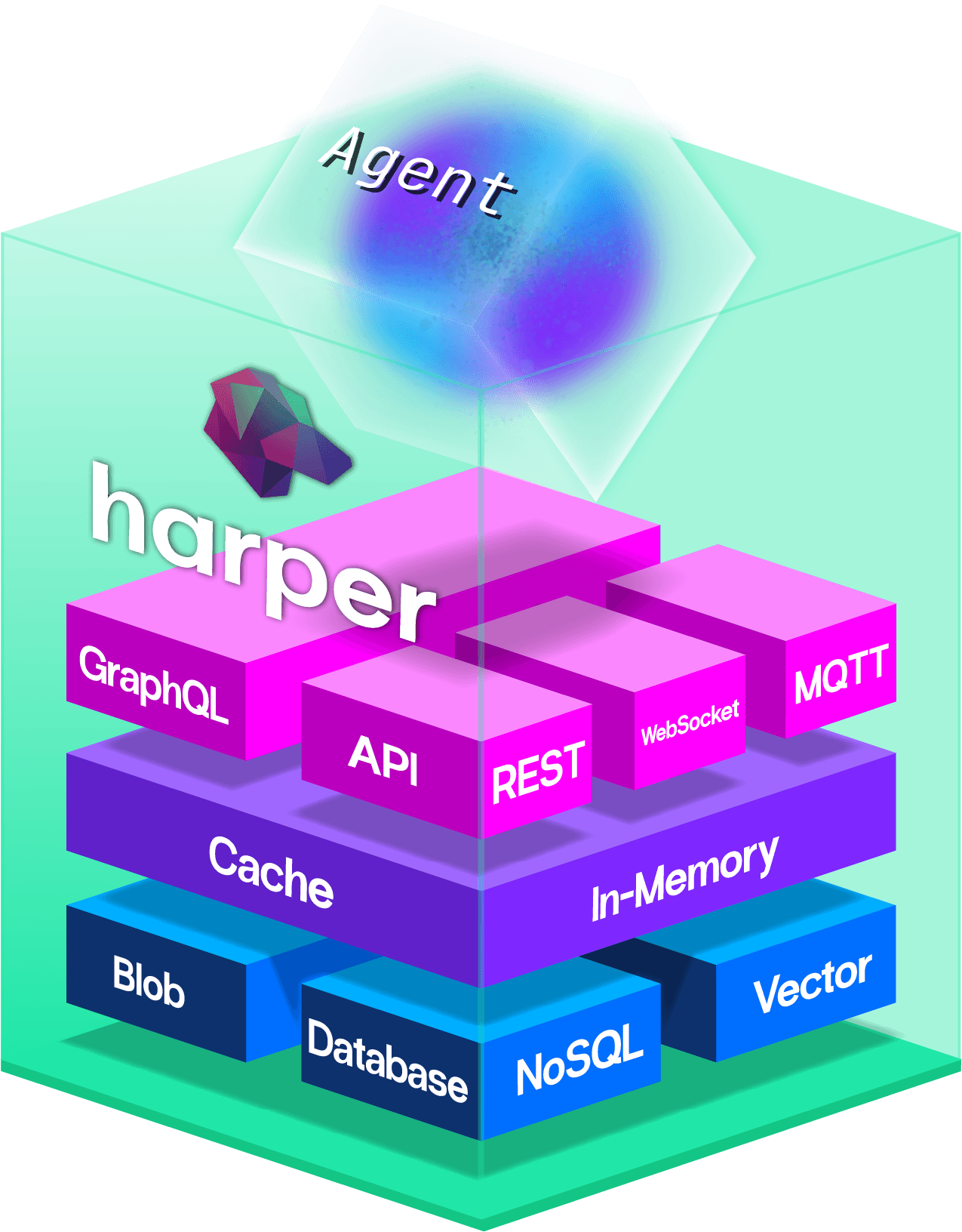
Harper changes the equation in a way that's almost unfairly well-suited for AI-assisted development. Here's why: with Harper, your entire application stack, database schema, API layer, custom business logic, static file hosting, is defined in configuration files that live in your project repo.
Your data model? It's a schema.graphql file:
type Dog @table @export {
id: ID @primaryKey
name: String
breed: String
owner: Owner @reference
}
type Owner @table @export {
id: ID @primaryKey
name: String
email: String
dogs: [Dog]
}‍
Your application configuration? It's a config.yaml:
http:
port: 9926
compressionThreshold: 1200
threads:
count: 2
databases:
- database: app
tables:
- table: Dog
schema: schema.graphql
- table: Owner
schema: schema.graphql‍
Your API endpoints? They're JavaScript resource files sitting right alongside everything else in the project directory.
With the @export declaration this also exposes Harper’s base REST, MQTT, WS, SSR interfaces. SO in some use cases there is truly no need for code and the entire stack really is config. The JS Resources end up be additive "power" layers to stack.
That's it. That's your backend. Your database, your API, your hosting, all defined in human-readable (and more importantly, AI-readable) text files that live in a single repository.
Now think about what this means for Claude Code.
‍
Claude Code Doesn't Just Write Your App. It Deploys It.
When you pair Claude Code with Harper, something remarkable happens. Claude isn't just generating source code, it's defining and modifying your entire production infrastructure. Every file Claude touches is a file that directly controls how your application behaves in production.
Claude can:
- Define your data model by writing or editing `schema.graphql` and those changes propagate to your database, your API, and your type system simultaneously.
- Configure your application by modifying `config.yaml` setting up databases, tables, caching behavior, authentication, and hosting in one place.
- Write your business logic as Resource classes that extend Harper's built-in CRUD operations with custom authorization, validation, and transformation logic.
- Build your frontend with whatever framework you prefer, served directly by Harper alongside your API.
- Deploy the whole thing to Harper Fabric with a single push. Your code, your schema, your config, and your data layer, all moving together as one atomic unit.
- Commit it all to GitHub because the entire stack is just files in a repo.
There's no separate infrastructure-as-code layer. No Terraform files that drift from reality. No container orchestration configs that exist in a parallel universe from your application code. The application is the infrastructure. The config is the deployment.
‍
Why This Makes Claude Code Dramatically More Powerful
Here's the thing people miss about AI coding agents: their power isn't just about how well they write code. It's about the surface area they can operate on. The more of your system that's expressible as text files in a repository, the more an AI agent can own end-to-end.
With a traditional stack, Claude Code hits walls everywhere. It can write your Express routes, but it can't configure your AWS load balancer. It can generate Prisma migrations, but it can't set up your managed Postgres instance. It can scaffold a Next.js app, but it can't configure your Vercel project settings. At every layer boundary, the human has to step in, context-switch, and do manual work.
With Harper, those walls don't exist. The entire stack is Claude's domain. When Claude writes a new schema.graphql definition, it is creating the database table. When it edits config.yaml, it is configuring the production server. When it writes a Resource class, it is building the API. There's no translation layer between "code Claude writes" and "infrastructure that runs in production."
This isn't a subtle distinction. It's the difference between an AI that helps you write code and an AI that helps you ship software.
‍
An Architect and an Army of Engineers
The best way I can describe working with Claude Code + Harper is this: it's like having an architect and an army of engineers, all working at the speed of thought.
Claude Code brings the engineering army. It can generate components, write business logic, handle edge cases, write tests, refactor code all the things that traditionally require headcount and hours.
Harper brings the architecture. By collapsing the entire stack into a single, config-driven runtime, Harper gives Claude Code something no other platform does: a single mental model for the entire application. Claude doesn't need to understand the impedance mismatch between your ORM and your database, between your API framework and your hosting provider, between your local dev environment and your production deployment. It's all one thing.
And because it's all one thing, Claude can reason about it holistically. "Add a new entity to the data model, expose it via the API with role-based access control, and update the frontend to display it" isn't three separate tasks across three separate systems. It's a coherent set of changes to files in one project that Claude can execute in a single session.
‍
Local Changes, Global Deployment
There's a workflow pattern with Harper + Claude Code that feels almost magical once you experience it.
You work locally. Claude Code creates and edits files on your machine, schema definitions, config files, resource handlers, frontend components. You test everything against a local Harper instance. You iterate fast. You break things and fix them. It's a tight, responsive development loop.
Then, when you're ready, you push to GitHub. Harper Fabric picks up the changes and deploys them globally. The same files Claude was editing on your laptop are now running in production, distributed across Harper's edge network.
There's no build step to debug. No deployment pipeline to configure. No environment variable mismatch to track down. The files are the deployment. What Claude built locally is what runs in production.
This is what makes the combo genuinely production-grade. It's not that Claude Code writes better code with Harper (though the simplicity of Harper's API model does help). It's that Claude Code can own the entire lifecycle, from initial scaffolding to schema design to business logic to deployment, without ever hitting a wall that requires human intervention in a different tool, a different platform, or a different paradigm.
‍
The Prototype Trap
Let me come back to where I started, because I think this is the most important point.
Most AI-assisted development today produces prototypes. Impressive prototypes, sometimes. Prototypes that look and feel like real applications. But prototypes nonetheless, because the gap between "code that runs on my machine" and "application that runs in production" is still a gap that AI can't cross with traditional stacks.
You can see what happens when that gap disappears in my breakdown of how I built an AI ops assistant that replaced $2,400/month in SaaS in three days for under $100/month. The speed wasn’t the impressive part; AI can scaffold quickly. The difference was that it shipped as a real, production system because the infrastructure and application layer were defined together from the start.
Every additional service in your architecture is another gap. Every external platform is another set of credentials Claude can't manage, another CLI it can't run, another config format it needs to understand. The more complex your infrastructure, the more human glue work is required, and the less leverage you get from your AI agent.
Harper eliminates the gaps. One runtime. One project structure. One set of config files. One deployment target. The entire application, data layer, API layer, business logic, frontend, hosting, defined in files that an AI agent can read, write, reason about, and deploy.
That's not a feature. That's a paradigm shift.
‍
Try It
If you're already using Claude Code (and at this point, why wouldn't you be), try pointing it at a Harper project. Ask it to define a schema, build an API, create a frontend, and deploy to Fabric. Watch what happens when the AI doesn't have to stop at the boundary between "code" and "infrastructure."
You might stop building prototypes. You might start shipping products.
‍
Stephen Goldberg is a technical co-founder at Harper. You can find him building things that probably should have taken a team of ten at fabric.harper.fast.
‍


.jpg)