



Click Below to Get the Code

Browse, clone, and build from real-world templates powered by Harper.
News
GitHub Logo

Introducing the HarperDB Dev Center

HarperDB announces the launch of the HarperDB Dev Center, empowering developers and enterprises with 70 tutorials spanning 60 technologies and 10 programming languages. Simplified enterprise development with their Unified Backend technology.
Announcement
News
Announcement

Introducing the HarperDB Dev Center

By
Harper
August 2, 2023
By
Harper
August 2, 2023
By
Harper
August 2, 2023
August 2, 2023
HarperDB announces the launch of the HarperDB Dev Center, empowering developers and enterprises with 70 tutorials spanning 60 technologies and 10 programming languages. Simplified enterprise development with their Unified Backend technology.
Harper

[Denver, August 2, 2023] — HarperDB, a trailblazing force in the development technology arena, proudly announces the debut of the HarperDB Dev Center. This resource hub is set to empower developers and enterprises alike, providing them with the tools and knowledge to unleash the full potential of HarperDB and build exceptional applications with unparalleled ease.
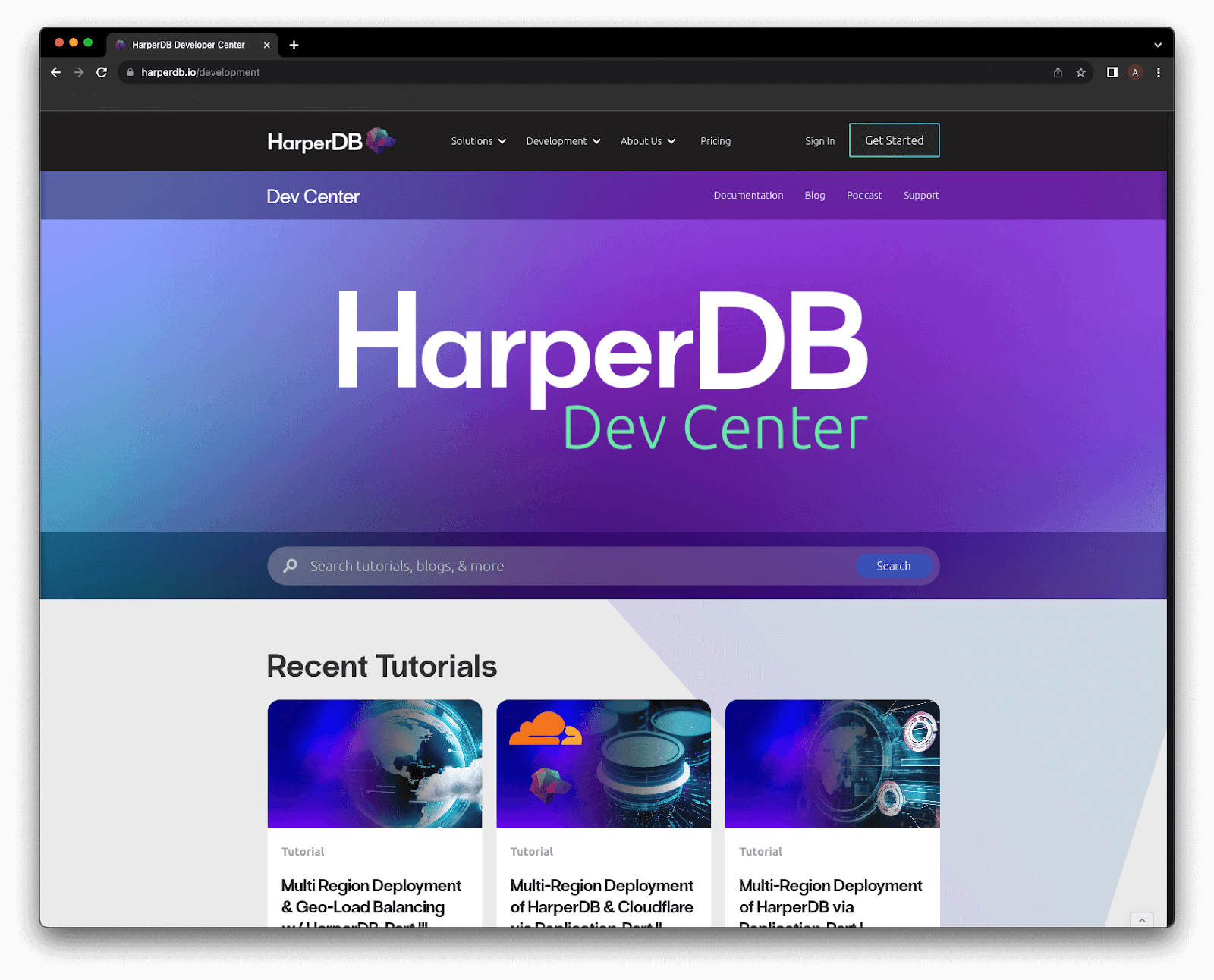
Screenshot of HarperDB Dev Center

The HarperDB Dev Center launches with 70 tutorials, allowing developers to dive right into their projects. Over time, the center will continue to expand with new tutorials added every week, ensuring that HarperDB’s groundbreaking technology becomes even more accessible. These tutorials span over 60 technologies, encompassing 28 development topics, and supporting over 15 languages. No matter the development scenario, HarperDB has the answer.

Aleks Haugom, Head of GTM Strategy at HarperDB, shares his insights, "One of the biggest challenges of selling HarperDB is convincing people just how simple enterprise development can be. Most developers have an expectation of complexity, especially for applications at scale. For decades the norm has been integrating multiple technologies like databases, application servers, and data streaming technologies to create complex stacks. HarperDB represents a fundamental shift in how we all build applications, merging these various technologies at the system level to make delivering high-performance apps easy."

By merging multiple technologies, HarperDB empowers developers to focus on the creative aspect of application building without being bogged down by intricate technology integrations and maintenance. This fundamental shift in approach sets HarperDB apart and enables developers to deliver top-tier, high-performance applications like never before.

HarperDB believes that anything can be built better with its revolutionary Unified Backend technology. With the Dev Center, HarperDB is determined to equip developers worldwide with the tools and knowledge they need to drive innovation and create extraordinary experiences.

The HarperDB Dev Center is now live and accessible to all developers. To experience the power of simplicity firsthand and embark on a journey of exceptional enterprise development, visit www.harperdb.io/development today! (Looking for a specific resource that you don’t see in the Dev Center? Let us know!)

About HarperDB

HarperDB is a globally-distributed edge application platform. It reduces complexity, increases performance, and lowers costs by combining user-defined applications, a high-performance database, and an enterprise-grade message queue into a single package. The platform offers unlimited horizontal scale at the click of a button, and synchronizes data across all the nodes in a cluster in milliseconds. HarperDB simplifies the process of delivering applications and the data that drives them to the edge, which dramatically improves both the user experience and total cost of ownership for large-scale applications. Deploying HarperDB on global infrastructure enables a CDN-like solution for enterprise data and applications.


[Denver, August 2, 2023] — HarperDB, a trailblazing force in the development technology arena, proudly announces the debut of the HarperDB Dev Center. This resource hub is set to empower developers and enterprises alike, providing them with the tools and knowledge to unleash the full potential of HarperDB and build exceptional applications with unparalleled ease.

Screenshot of HarperDB Dev Center

The HarperDB Dev Center launches with 70 tutorials, allowing developers to dive right into their projects. Over time, the center will continue to expand with new tutorials added every week, ensuring that HarperDB’s groundbreaking technology becomes even more accessible. These tutorials span over 60 technologies, encompassing 28 development topics, and supporting over 15 languages. No matter the development scenario, HarperDB has the answer.

Aleks Haugom, Head of GTM Strategy at HarperDB, shares his insights, "One of the biggest challenges of selling HarperDB is convincing people just how simple enterprise development can be. Most developers have an expectation of complexity, especially for applications at scale. For decades the norm has been integrating multiple technologies like databases, application servers, and data streaming technologies to create complex stacks. HarperDB represents a fundamental shift in how we all build applications, merging these various technologies at the system level to make delivering high-performance apps easy."

By merging multiple technologies, HarperDB empowers developers to focus on the creative aspect of application building without being bogged down by intricate technology integrations and maintenance. This fundamental shift in approach sets HarperDB apart and enables developers to deliver top-tier, high-performance applications like never before.

HarperDB believes that anything can be built better with its revolutionary Unified Backend technology. With the Dev Center, HarperDB is determined to equip developers worldwide with the tools and knowledge they need to drive innovation and create extraordinary experiences.

The HarperDB Dev Center is now live and accessible to all developers. To experience the power of simplicity firsthand and embark on a journey of exceptional enterprise development, visit www.harperdb.io/development today! (Looking for a specific resource that you don’t see in the Dev Center? Let us know!)

About HarperDB

HarperDB is a globally-distributed edge application platform. It reduces complexity, increases performance, and lowers costs by combining user-defined applications, a high-performance database, and an enterprise-grade message queue into a single package. The platform offers unlimited horizontal scale at the click of a button, and synchronizes data across all the nodes in a cluster in milliseconds. HarperDB simplifies the process of delivering applications and the data that drives them to the edge, which dramatically improves both the user experience and total cost of ownership for large-scale applications. Deploying HarperDB on global infrastructure enables a CDN-like solution for enterprise data and applications.

HarperDB announces the launch of the HarperDB Dev Center, empowering developers and enterprises with 70 tutorials spanning 60 technologies and 10 programming languages. Simplified enterprise development with their Unified Backend technology.

Download

White arrow pointing right
HarperDB announces the launch of the HarperDB Dev Center, empowering developers and enterprises with 70 tutorials spanning 60 technologies and 10 programming languages. Simplified enterprise development with their Unified Backend technology.

Download

White arrow pointing right
HarperDB announces the launch of the HarperDB Dev Center, empowering developers and enterprises with 70 tutorials spanning 60 technologies and 10 programming languages. Simplified enterprise development with their Unified Backend technology.

Download

White arrow pointing right

Explore Recent Resources

News
GitHub Logo

Harper 5.0 Is Here: Open Source, RocksDB, and a Runtime Built for the Agentic Era

Harper 5.0 launches with a fully open-source core under Apache 2.0, RocksDB as a native storage engine alongside LMDB, and source-available Harper Pro. This release delivers a unified runtime purpose-built for agentic engineering, from prototype to production.
Product Update
News
Harper 5.0 launches with a fully open-source core under Apache 2.0, RocksDB as a native storage engine alongside LMDB, and source-available Harper Pro. This release delivers a unified runtime purpose-built for agentic engineering, from prototype to production.
Person with short dark hair and moustache, wearing a colorful plaid shirt, smiling outdoors in a forested mountain landscape.
Aleks Haugom
Senior Manager of GTM & Marketing
News

Harper 5.0 Is Here: Open Source, RocksDB, and a Runtime Built for the Agentic Era

Harper 5.0 launches with a fully open-source core under Apache 2.0, RocksDB as a native storage engine alongside LMDB, and source-available Harper Pro. This release delivers a unified runtime purpose-built for agentic engineering, from prototype to production.
Aleks Haugom
Apr 2026
News

Harper 5.0 Is Here: Open Source, RocksDB, and a Runtime Built for the Agentic Era

Harper 5.0 launches with a fully open-source core under Apache 2.0, RocksDB as a native storage engine alongside LMDB, and source-available Harper Pro. This release delivers a unified runtime purpose-built for agentic engineering, from prototype to production.
Aleks Haugom
News

Harper 5.0 Is Here: Open Source, RocksDB, and a Runtime Built for the Agentic Era

Harper 5.0 launches with a fully open-source core under Apache 2.0, RocksDB as a native storage engine alongside LMDB, and source-available Harper Pro. This release delivers a unified runtime purpose-built for agentic engineering, from prototype to production.
Aleks Haugom
Podcast
GitHub Logo

Maintaining Momentum: Versioning, Stability & the Road to Nuxt 5 with Daniel Roe

In this podcast episode, Daniel Roe, lead of the Nuxt framework, shares insights on Nuxt 3, 4, and the upcoming Nuxt 5 release. We discuss open-source development, upgrading Nuxt apps, Vue-powered full-stack web apps, version maintenance, and the future of modern web development.
Select*
Podcast
In this podcast episode, Daniel Roe, lead of the Nuxt framework, shares insights on Nuxt 3, 4, and the upcoming Nuxt 5 release. We discuss open-source development, upgrading Nuxt apps, Vue-powered full-stack web apps, version maintenance, and the future of modern web development.
Person with short hair wearing a light blue patterned shirt, smiling widely outdoors with blurred greenery and trees in the background.
Austin Akers
Head of Developer Relations
Podcast

Maintaining Momentum: Versioning, Stability & the Road to Nuxt 5 with Daniel Roe

In this podcast episode, Daniel Roe, lead of the Nuxt framework, shares insights on Nuxt 3, 4, and the upcoming Nuxt 5 release. We discuss open-source development, upgrading Nuxt apps, Vue-powered full-stack web apps, version maintenance, and the future of modern web development.
Austin Akers
Apr 2026
Podcast

Maintaining Momentum: Versioning, Stability & the Road to Nuxt 5 with Daniel Roe

In this podcast episode, Daniel Roe, lead of the Nuxt framework, shares insights on Nuxt 3, 4, and the upcoming Nuxt 5 release. We discuss open-source development, upgrading Nuxt apps, Vue-powered full-stack web apps, version maintenance, and the future of modern web development.
Austin Akers
Podcast

Maintaining Momentum: Versioning, Stability & the Road to Nuxt 5 with Daniel Roe

In this podcast episode, Daniel Roe, lead of the Nuxt framework, shares insights on Nuxt 3, 4, and the upcoming Nuxt 5 release. We discuss open-source development, upgrading Nuxt apps, Vue-powered full-stack web apps, version maintenance, and the future of modern web development.
Austin Akers
Blog
GitHub Logo

Most LLM Calls Are Waste. Here's the Math.

Semantic caching for LLMs can reduce API costs by 20–70% by reusing similar responses. Combined with deterministic routing and improved retrieval, enterprises can significantly lower LLM usage, though effectiveness varies by workload and improves over time.
Blog
Semantic caching for LLMs can reduce API costs by 20–70% by reusing similar responses. Combined with deterministic routing and improved retrieval, enterprises can significantly lower LLM usage, though effectiveness varies by workload and improves over time.
Person with short dark hair and moustache, wearing a colorful plaid shirt, smiling outdoors in a forested mountain landscape.
Aleks Haugom
Senior Manager of GTM & Marketing
Blog

Most LLM Calls Are Waste. Here's the Math.

Semantic caching for LLMs can reduce API costs by 20–70% by reusing similar responses. Combined with deterministic routing and improved retrieval, enterprises can significantly lower LLM usage, though effectiveness varies by workload and improves over time.
Aleks Haugom
Apr 2026
Blog

Most LLM Calls Are Waste. Here's the Math.

Semantic caching for LLMs can reduce API costs by 20–70% by reusing similar responses. Combined with deterministic routing and improved retrieval, enterprises can significantly lower LLM usage, though effectiveness varies by workload and improves over time.
Aleks Haugom
Blog

Most LLM Calls Are Waste. Here's the Math.

Semantic caching for LLMs can reduce API costs by 20–70% by reusing similar responses. Combined with deterministic routing and improved retrieval, enterprises can significantly lower LLM usage, though effectiveness varies by workload and improves over time.
Aleks Haugom
Blog
GitHub Logo

Build a Conversational AI Agent on Harper in 5 Minutes

Build a conversational AI agent in minutes using Harper’s unified platform. This guide shows how to create, deploy, and scale real-time AI agents with built-in database, vector search, and APIs—eliminating infrastructure complexity for faster development.
Blog
Build a conversational AI agent in minutes using Harper’s unified platform. This guide shows how to create, deploy, and scale real-time AI agents with built-in database, vector search, and APIs—eliminating infrastructure complexity for faster development.
A smiling man with a beard and salt-and-pepper hair stands outdoors with arms crossed, wearing a white button-down shirt.
Stephen Goldberg
CEO & Co-Founder
Blog

Build a Conversational AI Agent on Harper in 5 Minutes

Build a conversational AI agent in minutes using Harper’s unified platform. This guide shows how to create, deploy, and scale real-time AI agents with built-in database, vector search, and APIs—eliminating infrastructure complexity for faster development.
Stephen Goldberg
Apr 2026
Blog

Build a Conversational AI Agent on Harper in 5 Minutes

Build a conversational AI agent in minutes using Harper’s unified platform. This guide shows how to create, deploy, and scale real-time AI agents with built-in database, vector search, and APIs—eliminating infrastructure complexity for faster development.
Stephen Goldberg
Blog

Build a Conversational AI Agent on Harper in 5 Minutes

Build a conversational AI agent in minutes using Harper’s unified platform. This guide shows how to create, deploy, and scale real-time AI agents with built-in database, vector search, and APIs—eliminating infrastructure complexity for faster development.
Stephen Goldberg
Podcast
GitHub Logo

Inside PixiJS, AT Protocol, and Modern Game Development with Trezy Who

Trezy shares his journey from professional drummer and filmmaker to software engineer and open source maintainer. Learn about PixieJS, game development, AT Proto, BlueSky, data sovereignty, and how developers can confidently contribute to open source projects.
Select*
Podcast
Trezy shares his journey from professional drummer and filmmaker to software engineer and open source maintainer. Learn about PixieJS, game development, AT Proto, BlueSky, data sovereignty, and how developers can confidently contribute to open source projects.
Person with short hair wearing a light blue patterned shirt, smiling widely outdoors with blurred greenery and trees in the background.
Austin Akers
Head of Developer Relations
Podcast

Inside PixiJS, AT Protocol, and Modern Game Development with Trezy Who

Trezy shares his journey from professional drummer and filmmaker to software engineer and open source maintainer. Learn about PixieJS, game development, AT Proto, BlueSky, data sovereignty, and how developers can confidently contribute to open source projects.
Austin Akers
Mar 2026
Podcast

Inside PixiJS, AT Protocol, and Modern Game Development with Trezy Who

Trezy shares his journey from professional drummer and filmmaker to software engineer and open source maintainer. Learn about PixieJS, game development, AT Proto, BlueSky, data sovereignty, and how developers can confidently contribute to open source projects.
Austin Akers
Podcast

Inside PixiJS, AT Protocol, and Modern Game Development with Trezy Who

Trezy shares his journey from professional drummer and filmmaker to software engineer and open source maintainer. Learn about PixieJS, game development, AT Proto, BlueSky, data sovereignty, and how developers can confidently contribute to open source projects.
Austin Akers