// ENTERPRISE

Unified Runtime for Agentic Engineering

Harper is the only runtime that enables coding agents to build and deploy enterprise-grade apps without giving them access to your infrastructure credentials and data.
Harper cube surrounded by a glowing layer, representing AI integration.
// WHY HARPER

Don’t just prototype. Build production software.

Agents can generate code in  seconds. Getting that code to production is the hard part, it needs  infrastructure, security, and operational trust. Harper gives agents a contained runtime where the entire stack is in the code. What they build locally is what you deploy. No credentials to hand over, no services to wire  up, no gap between prototype and production.
// GET STARTED

Agentic Engineering with Harper

1st: Scaffold ↓
2nd: Launch Agent ↓
Terminal
$ cd my-app
✓ navigate to your project

$ npm create harper@latest
✓ harper installed
✓ skills added
Claude Code
$ claude

Claude: reads skills/harper-best-practices on startup.

> Add vector search to the product table  with semantic similarity on descriptions

✓ Updated schema.graphql | description: [Float] @indexed(type: "HNSW")
✓ Created resources/search.ts using Harper's native vector search API
✓ No external vector DB. Runs in-process


OpenAI Codex
$ codex

Codex: indexes the full project including skills/ for Harper-specific patterns.

> Set up a caching layer that pulls  inventory data from our existing REST API

✓ Updated schema.graphql | type Inventory @table @cache(expiration: 3600)
✓ Created resources/inventory.ts get() fetches from external API, Harper caches
✓ ETag + stampede prevention built in

Google Antigravity
$ antigravity

Antigravity: loads skills/ alongside your schema and resource definitions.

> Add real-time order notifications over WebSocket when orders are created

✓ Updated resources/orders.ts publish('orders', record) on POST
✓ Created client/useOrders.ts subscribes via Harper's native pub/sub
✓ No message broker — WebSocket built in

Use Your Own AI Agent

Already using Claude Code, Codex, or Antigravity? Skills files give your existing agent full Harper runtime knowledge. No switching required.
1

Scaffold

npm create harper@latest adds Harper and its best practices to your project. Works with any agent that reads project-level files for context.
2

Launch

Claude Code, OpenAI Codex, and Google Antigravity all read project-level files as context. The skills/ directory is picked up automatically. No setup needed.
Works with any agent that reads project files for context.
3

Build

Your agent knows the exact  syntax for vector search, real-time pub/sub, caching, auth, and deployment.  No multi-service architecture, no drift. Works with your existing CI/CD  pipeline.

Try Harper Agent

OPEN ALPHA
Where skills teach external agents about Harper, Harper Agent is built to think in it. It scaffolds and codes entire projects contextually, generating structurally sound applications grounded in Harper's architecture from the first command.

Bring your own model API key to use this CLI-based tool. Harper Agent supports OpenAI, Anthropic, Google Gemini, and local models via Ollama.
Green Arrow
Generates Harper schemas, resources, and config grounded in runtime conventions
Green Arrow
Detects existing Harper projects and works within established structure
Green Arrow
Supports session persistence for long-running development workflows
Green Arrow
Non-interactive mode for piping prompts from specs or task files
Install Harper Agent
White arrow pointing right
Terminal
# Install globally
$ npm install -g @harperfast/agent

# Start in your project directory
$ harper-agent

Working directory: ~/Code/my-app
Harper app detected: Yes

Harper: What do you want to do together today?

> Create a support knowledge base that stores documents as blobs, indexes them with vector embeddings for semantic search, and pushes new article alerts via pub/sub.

# Or pipe a spec non-interactively
$ cat spec.md | harper-agent

Built Different

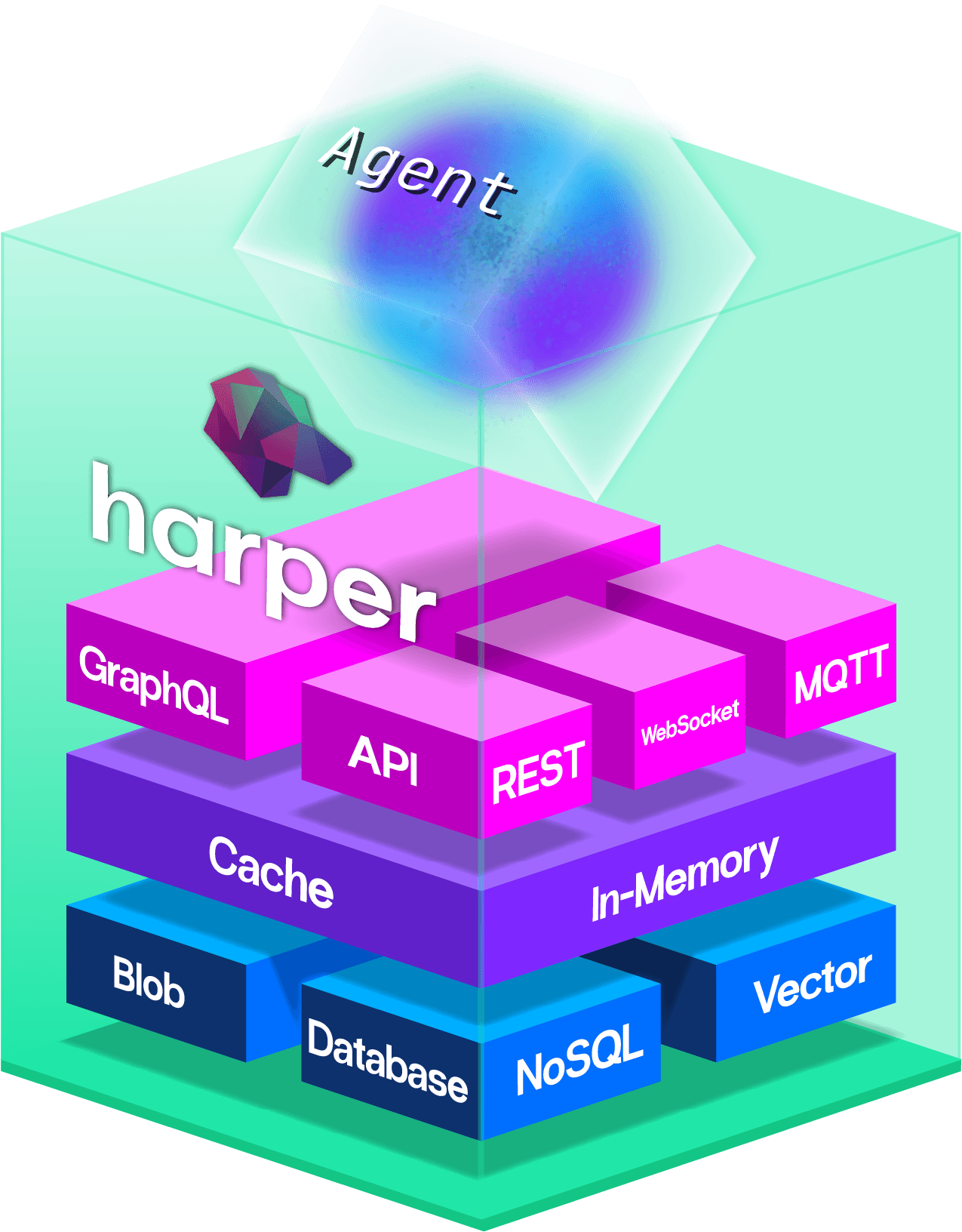
For most stacks, infrastructure lives outside the code, agents can’t reach it safely. On  Harper, the entire application surface is declarative and in-repo so agents control everything without touching production infra.
Harper LogoLayered Harper application platform stack showing GraphQL, API, REST, WebSocket, and MQTT on top of cache and in-memory layers, with database, NoSQL, blob, and vector storage beneath, and AI coding tools above.
TYPICAL
ARCHITECTURE
Configuration Model
config.yamlDeclrative, editable by AI
Distributed configs (Terraform, cloud consoles, service dashboards)
API Definition
schema.graphqlAuto-generated API layer
Custom server setup + framework wiring
Business Logic
resource.jsExecuted within unified runtime
Separate service, separate runtime, separate deploy
Database Provisioning
Built-in (NoSQL, Blob, Vector, Cache)
Manual provisioning (MongoDB, Postgres, Redis, etc.)
Deployment Model
Harper Fabric deploys directly from Harper configuration
CI/CD pipelines + cloud infra coordination
Multi-Region Deployment
Native, built into Harper Fabric
Complex setup across providers
AI Agent Control Surface
Entire stack accessible through files AI can modify
Infra lives outside code; AI cannot provision safely
Human-in-the-Loop Required
No
Yes (DevOps + cloud permissions required)
Operational Complexity
Minimal, single runtime
High, service coordination and integration overhead
P95 Server Latency
1–10 ms
50–200 ms typical
Production Readiness
Includes all core services
Requires stitching multiple services together
Open Source
Yes
Varies

What Makes This Possible?
Declarative files give agents full control of the stack, without full access to your credentials or data.
// DEPLOY TODAY 

Prompt. Ship. Scale.

Start free on Harper Fabric. No credit card required. Your first deployment is minutes away.