



Click Below to Get the Code

Browse, clone, and build from real-world templates powered by Harper.
Case Study
GitHub Logo

The Impact of Early Hints - Mid-Market

A U.S. mid-market online retailer struggling with Core Web Vitals and mobile performance saw search visibility and engagement plateau despite ongoing optimization efforts. By deploying Harper’s Early Hints technology in a 30-day proof of concept, the retailer achieved faster load times, 72% fewer poor mobile URLs, and an estimated $600K annual revenue uplift with minimal engineering effort.
Case Study

The Impact of Early Hints - Mid-Market

By
Harper
September 17, 2025
By
Harper
September 17, 2025
By
Harper
September 17, 2025
September 17, 2025
A U.S. mid-market online retailer struggling with Core Web Vitals and mobile performance saw search visibility and engagement plateau despite ongoing optimization efforts. By deploying Harper’s Early Hints technology in a 30-day proof of concept, the retailer achieved faster load times, 72% fewer poor mobile URLs, and an estimated $600K annual revenue uplift with minimal engineering effort.
Harper

Summary

A U.S. mid-market online retailer with a large product catalog was struggling with Core Web Vitals and site performance, limiting growth in search visibility and customer engagement. Despite steady investment in optimization, mobile scores showed widespread failures, creating a ceiling on revenue expansion. By deploying Harper’s Early Hints technology in a 30-day proof of concept (POC), the retailer achieved faster load times, significant improvements in Core Web Vitals, and measurable gains in user engagement. With minimal engineering effort and rapid rollout, the POC demonstrated clear business impact and established a strong case for scaling performance enhancements across the digital experience.

Context

This retailer manages a broad direct-to-consumer catalog with thousands of products. As organic search continued to drive a growing share of sessions, performance became critical for both customer experience and indexation. Yet Google Search Console showed that the majority of URLs were in the “Poor” category for LCP and CLS, restricting visibility and leaving revenue untapped. Leadership recognized that without a step-change in performance, marketing spend would plateau in effectiveness, and growth would stagnate.
The Problem

  • Core Web Vitals failures: The Majority of mobile URLs are flagged as poor
  • SEO growth limits: Indexation and visibility constrained by slow performance
  • Inefficient engagement: Customers viewed fewer pages per session
  • Risk of stagnation: Ongoing investment without proportional returns

The Solution: Early Hints

Harper partnered with the retailer to implement Early Hints, a distributed edge capability that preloads critical assets before full HTML is returned. By accelerating time-to-first-byte and largest contentful paint, Early Hints improved both customer experience and search engine responsiveness.

The proof of concept was deployed in less than 30 days with no refactoring of the retailer’s application. Early Hints was activated through platform configuration, making the rollout low-risk and minimally disruptive.

The Outcome

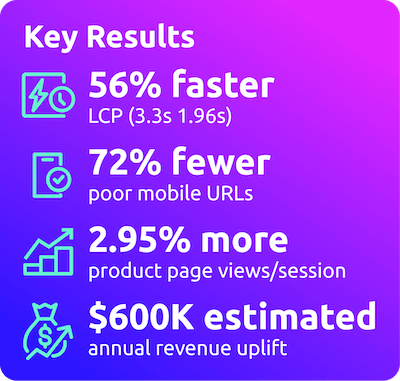
The POC generated clear improvements across performance, Core Web Vitals, and user engagement. Median LCP dropped by more than 1.3 seconds, a 56% reduction that moved a large share of mobile pages out of the “Poor” category. CLS also improved, with poor URLs decreasing by nearly 72%.

On the customer side, engagement metrics improved measurably within the Early Hints test group. Sessions were longer, product pages viewed per session rose by nearly 3%, and overall page views per session increased as well.

When modeled against industry benchmarks that link speed to conversion, the gains were estimated to result in a $600,000 annual revenue uplift. This established a compelling business case, based on a 6x ROI, for expanding Early Hints and exploring further enhancements, such as prerendering and advanced caching.

Conclusion & Path Forward

The POC validated that targeted acceleration of page loads delivers measurable SEO and revenue benefits for retailers with large catalogs. Building on these results, the next step is to roll out Early Hints site-wide and pursue additional strategies such as prerendering and advanced caching. Together, these improvements will move Core Web Vitals into the green range, securing long-term competitiveness and sustainable growth. For large-scale e-commerce organizations, performance is not just a technical metric—it is a revenue strategy.

Summary

A U.S. mid-market online retailer with a large product catalog was struggling with Core Web Vitals and site performance, limiting growth in search visibility and customer engagement. Despite steady investment in optimization, mobile scores showed widespread failures, creating a ceiling on revenue expansion. By deploying Harper’s Early Hints technology in a 30-day proof of concept (POC), the retailer achieved faster load times, significant improvements in Core Web Vitals, and measurable gains in user engagement. With minimal engineering effort and rapid rollout, the POC demonstrated clear business impact and established a strong case for scaling performance enhancements across the digital experience.

Context

This retailer manages a broad direct-to-consumer catalog with thousands of products. As organic search continued to drive a growing share of sessions, performance became critical for both customer experience and indexation. Yet Google Search Console showed that the majority of URLs were in the “Poor” category for LCP and CLS, restricting visibility and leaving revenue untapped. Leadership recognized that without a step-change in performance, marketing spend would plateau in effectiveness, and growth would stagnate.

The Problem

  • Core Web Vitals failures: The Majority of mobile URLs are flagged as poor
  • SEO growth limits: Indexation and visibility constrained by slow performance
  • Inefficient engagement: Customers viewed fewer pages per session
  • Risk of stagnation: Ongoing investment without proportional returns

The Solution: Early Hints

Harper partnered with the retailer to implement Early Hints, a distributed edge capability that preloads critical assets before full HTML is returned. By accelerating time-to-first-byte and largest contentful paint, Early Hints improved both customer experience and search engine responsiveness.

The proof of concept was deployed in less than 30 days with no refactoring of the retailer’s application. Early Hints was activated through platform configuration, making the rollout low-risk and minimally disruptive.

The Outcome

The POC generated clear improvements across performance, Core Web Vitals, and user engagement. Median LCP dropped by more than 1.3 seconds, a 56% reduction that moved a large share of mobile pages out of the “Poor” category. CLS also improved, with poor URLs decreasing by nearly 72%.

On the customer side, engagement metrics improved measurably within the Early Hints test group. Sessions were longer, product pages viewed per session rose by nearly 3%, and overall page views per session increased as well.

When modeled against industry benchmarks that link speed to conversion, the gains were estimated to result in a $600,000 annual revenue uplift. This established a compelling business case, based on a 6x ROI, for expanding Early Hints and exploring further enhancements, such as prerendering and advanced caching.

Conclusion & Path Forward

The POC validated that targeted acceleration of page loads delivers measurable SEO and revenue benefits for retailers with large catalogs. Building on these results, the next step is to roll out Early Hints site-wide and pursue additional strategies such as prerendering and advanced caching. Together, these improvements will move Core Web Vitals into the green range, securing long-term competitiveness and sustainable growth. For large-scale e-commerce organizations, performance is not just a technical metric—it is a revenue strategy.

A U.S. mid-market online retailer struggling with Core Web Vitals and mobile performance saw search visibility and engagement plateau despite ongoing optimization efforts. By deploying Harper’s Early Hints technology in a 30-day proof of concept, the retailer achieved faster load times, 72% fewer poor mobile URLs, and an estimated $600K annual revenue uplift with minimal engineering effort.

Download

White arrow pointing right
A U.S. mid-market online retailer struggling with Core Web Vitals and mobile performance saw search visibility and engagement plateau despite ongoing optimization efforts. By deploying Harper’s Early Hints technology in a 30-day proof of concept, the retailer achieved faster load times, 72% fewer poor mobile URLs, and an estimated $600K annual revenue uplift with minimal engineering effort.

Download

White arrow pointing right
A U.S. mid-market online retailer struggling with Core Web Vitals and mobile performance saw search visibility and engagement plateau despite ongoing optimization efforts. By deploying Harper’s Early Hints technology in a 30-day proof of concept, the retailer achieved faster load times, 72% fewer poor mobile URLs, and an estimated $600K annual revenue uplift with minimal engineering effort.

Download

White arrow pointing right

Explore Recent Resources

News
GitHub Logo

Harper 5.0 Is Here: Open Source, RocksDB, and a Runtime Built for the Agentic Era

Harper 5.0 launches with a fully open-source core under Apache 2.0, RocksDB as a native storage engine alongside LMDB, and source-available Harper Pro. This release delivers a unified runtime purpose-built for agentic engineering, from prototype to production.
Product Update
News
Harper 5.0 launches with a fully open-source core under Apache 2.0, RocksDB as a native storage engine alongside LMDB, and source-available Harper Pro. This release delivers a unified runtime purpose-built for agentic engineering, from prototype to production.
Person with short dark hair and moustache, wearing a colorful plaid shirt, smiling outdoors in a forested mountain landscape.
Aleks Haugom
Senior Manager of GTM & Marketing
News

Harper 5.0 Is Here: Open Source, RocksDB, and a Runtime Built for the Agentic Era

Harper 5.0 launches with a fully open-source core under Apache 2.0, RocksDB as a native storage engine alongside LMDB, and source-available Harper Pro. This release delivers a unified runtime purpose-built for agentic engineering, from prototype to production.
Aleks Haugom
Apr 2026
News

Harper 5.0 Is Here: Open Source, RocksDB, and a Runtime Built for the Agentic Era

Harper 5.0 launches with a fully open-source core under Apache 2.0, RocksDB as a native storage engine alongside LMDB, and source-available Harper Pro. This release delivers a unified runtime purpose-built for agentic engineering, from prototype to production.
Aleks Haugom
News

Harper 5.0 Is Here: Open Source, RocksDB, and a Runtime Built for the Agentic Era

Harper 5.0 launches with a fully open-source core under Apache 2.0, RocksDB as a native storage engine alongside LMDB, and source-available Harper Pro. This release delivers a unified runtime purpose-built for agentic engineering, from prototype to production.
Aleks Haugom
Podcast
GitHub Logo

Maintaining Momentum: Versioning, Stability & the Road to Nuxt 5 with Daniel Roe

In this podcast episode, Daniel Roe, lead of the Nuxt framework, shares insights on Nuxt 3, 4, and the upcoming Nuxt 5 release. We discuss open-source development, upgrading Nuxt apps, Vue-powered full-stack web apps, version maintenance, and the future of modern web development.
Select*
Podcast
In this podcast episode, Daniel Roe, lead of the Nuxt framework, shares insights on Nuxt 3, 4, and the upcoming Nuxt 5 release. We discuss open-source development, upgrading Nuxt apps, Vue-powered full-stack web apps, version maintenance, and the future of modern web development.
Person with short hair wearing a light blue patterned shirt, smiling widely outdoors with blurred greenery and trees in the background.
Austin Akers
Head of Developer Relations
Podcast

Maintaining Momentum: Versioning, Stability & the Road to Nuxt 5 with Daniel Roe

In this podcast episode, Daniel Roe, lead of the Nuxt framework, shares insights on Nuxt 3, 4, and the upcoming Nuxt 5 release. We discuss open-source development, upgrading Nuxt apps, Vue-powered full-stack web apps, version maintenance, and the future of modern web development.
Austin Akers
Apr 2026
Podcast

Maintaining Momentum: Versioning, Stability & the Road to Nuxt 5 with Daniel Roe

In this podcast episode, Daniel Roe, lead of the Nuxt framework, shares insights on Nuxt 3, 4, and the upcoming Nuxt 5 release. We discuss open-source development, upgrading Nuxt apps, Vue-powered full-stack web apps, version maintenance, and the future of modern web development.
Austin Akers
Podcast

Maintaining Momentum: Versioning, Stability & the Road to Nuxt 5 with Daniel Roe

In this podcast episode, Daniel Roe, lead of the Nuxt framework, shares insights on Nuxt 3, 4, and the upcoming Nuxt 5 release. We discuss open-source development, upgrading Nuxt apps, Vue-powered full-stack web apps, version maintenance, and the future of modern web development.
Austin Akers
Blog
GitHub Logo

Most LLM Calls Are Waste. Here's the Math.

Semantic caching for LLMs can reduce API costs by 20–70% by reusing similar responses. Combined with deterministic routing and improved retrieval, enterprises can significantly lower LLM usage, though effectiveness varies by workload and improves over time.
Blog
Semantic caching for LLMs can reduce API costs by 20–70% by reusing similar responses. Combined with deterministic routing and improved retrieval, enterprises can significantly lower LLM usage, though effectiveness varies by workload and improves over time.
Person with short dark hair and moustache, wearing a colorful plaid shirt, smiling outdoors in a forested mountain landscape.
Aleks Haugom
Senior Manager of GTM & Marketing
Blog

Most LLM Calls Are Waste. Here's the Math.

Semantic caching for LLMs can reduce API costs by 20–70% by reusing similar responses. Combined with deterministic routing and improved retrieval, enterprises can significantly lower LLM usage, though effectiveness varies by workload and improves over time.
Aleks Haugom
Apr 2026
Blog

Most LLM Calls Are Waste. Here's the Math.

Semantic caching for LLMs can reduce API costs by 20–70% by reusing similar responses. Combined with deterministic routing and improved retrieval, enterprises can significantly lower LLM usage, though effectiveness varies by workload and improves over time.
Aleks Haugom
Blog

Most LLM Calls Are Waste. Here's the Math.

Semantic caching for LLMs can reduce API costs by 20–70% by reusing similar responses. Combined with deterministic routing and improved retrieval, enterprises can significantly lower LLM usage, though effectiveness varies by workload and improves over time.
Aleks Haugom
Blog
GitHub Logo

Build a Conversational AI Agent on Harper in 5 Minutes

Build a conversational AI agent in minutes using Harper’s unified platform. This guide shows how to create, deploy, and scale real-time AI agents with built-in database, vector search, and APIs—eliminating infrastructure complexity for faster development.
Blog
Build a conversational AI agent in minutes using Harper’s unified platform. This guide shows how to create, deploy, and scale real-time AI agents with built-in database, vector search, and APIs—eliminating infrastructure complexity for faster development.
A smiling man with a beard and salt-and-pepper hair stands outdoors with arms crossed, wearing a white button-down shirt.
Stephen Goldberg
CEO & Co-Founder
Blog

Build a Conversational AI Agent on Harper in 5 Minutes

Build a conversational AI agent in minutes using Harper’s unified platform. This guide shows how to create, deploy, and scale real-time AI agents with built-in database, vector search, and APIs—eliminating infrastructure complexity for faster development.
Stephen Goldberg
Apr 2026
Blog

Build a Conversational AI Agent on Harper in 5 Minutes

Build a conversational AI agent in minutes using Harper’s unified platform. This guide shows how to create, deploy, and scale real-time AI agents with built-in database, vector search, and APIs—eliminating infrastructure complexity for faster development.
Stephen Goldberg
Blog

Build a Conversational AI Agent on Harper in 5 Minutes

Build a conversational AI agent in minutes using Harper’s unified platform. This guide shows how to create, deploy, and scale real-time AI agents with built-in database, vector search, and APIs—eliminating infrastructure complexity for faster development.
Stephen Goldberg
Podcast
GitHub Logo

Inside PixiJS, AT Protocol, and Modern Game Development with Trezy Who

Trezy shares his journey from professional drummer and filmmaker to software engineer and open source maintainer. Learn about PixieJS, game development, AT Proto, BlueSky, data sovereignty, and how developers can confidently contribute to open source projects.
Select*
Podcast
Trezy shares his journey from professional drummer and filmmaker to software engineer and open source maintainer. Learn about PixieJS, game development, AT Proto, BlueSky, data sovereignty, and how developers can confidently contribute to open source projects.
Person with short hair wearing a light blue patterned shirt, smiling widely outdoors with blurred greenery and trees in the background.
Austin Akers
Head of Developer Relations
Podcast

Inside PixiJS, AT Protocol, and Modern Game Development with Trezy Who

Trezy shares his journey from professional drummer and filmmaker to software engineer and open source maintainer. Learn about PixieJS, game development, AT Proto, BlueSky, data sovereignty, and how developers can confidently contribute to open source projects.
Austin Akers
Mar 2026
Podcast

Inside PixiJS, AT Protocol, and Modern Game Development with Trezy Who

Trezy shares his journey from professional drummer and filmmaker to software engineer and open source maintainer. Learn about PixieJS, game development, AT Proto, BlueSky, data sovereignty, and how developers can confidently contribute to open source projects.
Austin Akers
Podcast

Inside PixiJS, AT Protocol, and Modern Game Development with Trezy Who

Trezy shares his journey from professional drummer and filmmaker to software engineer and open source maintainer. Learn about PixieJS, game development, AT Proto, BlueSky, data sovereignty, and how developers can confidently contribute to open source projects.
Austin Akers