



Click Below to Get the Code

Browse, clone, and build from real-world templates powered by Harper.
Solution
GitHub Logo

SEO Website Performance

Harper’s collection of turn-key, enterprise-grade components is designed to improve performance and maximize revenue at any scale.
Solution

SEO Website Performance

By
Harper
April 14, 2025
By
Harper
April 14, 2025
By
Harper
April 14, 2025
April 14, 2025
Harper’s collection of turn-key, enterprise-grade components is designed to improve performance and maximize revenue at any scale.
Harper

Performance Challenges

E-commerce success hinges on delivering fast and efficient web pages. However, achieving optimal SEO and user experience can be challenging with vast or dynamic product catalogs. Traditional tech stacks simply can’t keep up. Common challenges include:

Page Load Latency:

Excessive network hops and system complexity slow down product pages, impacting search engine rankings.

Catalog Scale vs SEO Bot Performance:

For large product catalogs, SEO optimizations often outpace search engines’ ability to index them, limiting revenue potential.

Redirect Optimization:

Frequent catalog updates and optimizations can lead to convoluted, circular, or chained redirect logic that can negatively impact search rankings.

Core Web Vitals:

Optimizing TTFB, LCP, and INP is crucial for top search rankings, but often requires dynamic content capabilities working in concert with your CDN.
Performance Enhancement Strategies

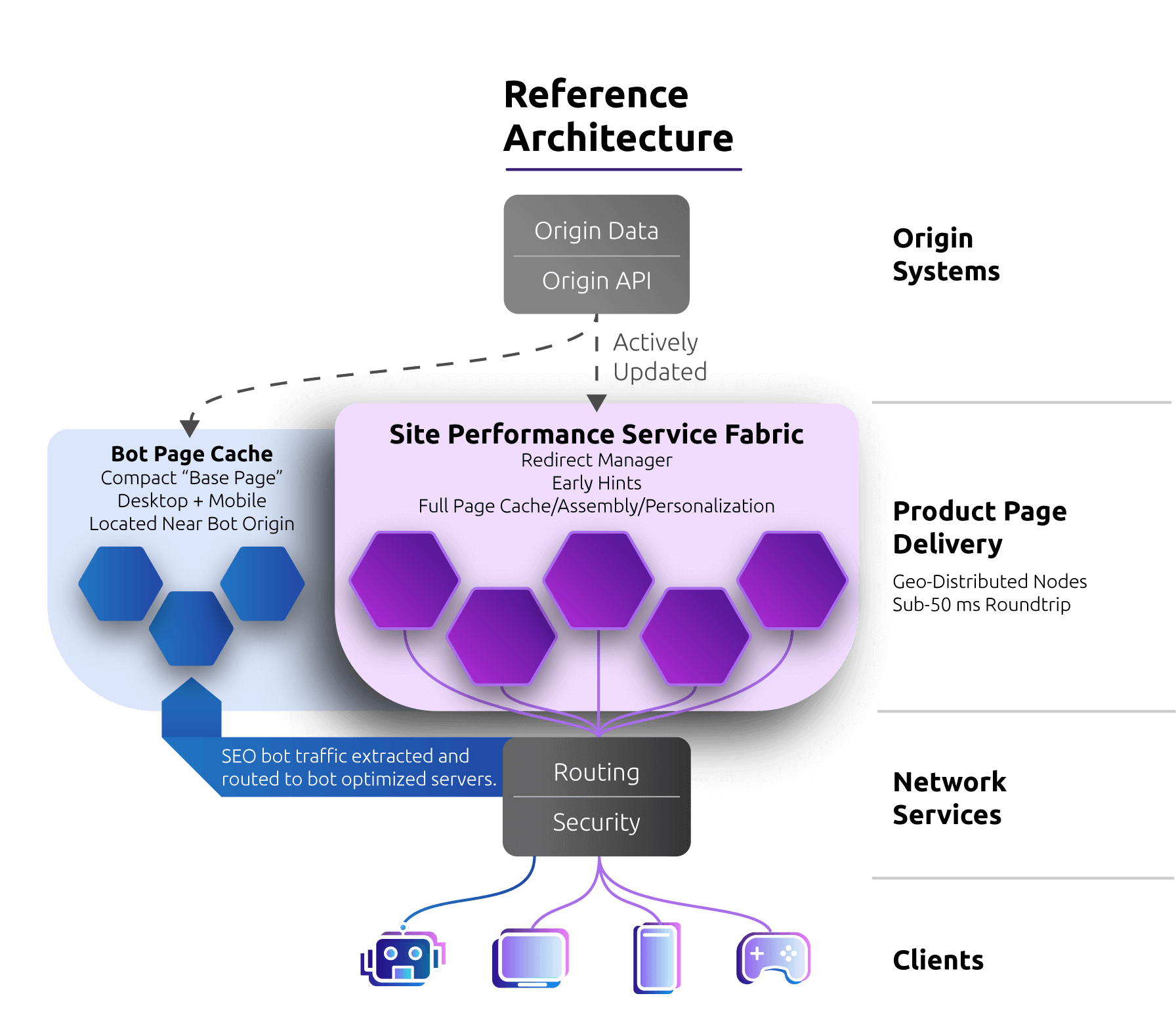
Harper combines an API, In-Memory Cache, and High-Performance Database into a single package, delivering unmatched low latency, security, and value to your application. We then distribute and synchronize your applications and data close to every user, further improving latency and delivering unparalleled resiliency.

Most digital commerce customers encounter similar challenges as they scale, so Harper has created several open-source components that serve as starting points for site optimization. Our team of solution architects can work with you to select, configure, and deploy any number of these components to meet your performance goals, or you can clone and extend them yourself.
Early Hints

Improving core web vitals (CWV) by returning partial responses that outline assets to be downloaded before the page's HTML. Assets that benefit from early hints include hero images to help with LCP (Largest Contentful Paint) and other static assets such as CSS and JS files. The solution works seamlessly with your CDN to ensure the lowest possible latency, no matter how extensive your product catalog may be.   

Redirect Management

Frequent page and URL updates are all too common. As URLs shift, redirect chains can lengthen, significantly slowing page load times. Harper overcomes this challenge with submillisecond redirect lookups at the front edge of an SEO Service Fabric, getting customers to the right page without delay.  

SEO Bot Page Caching

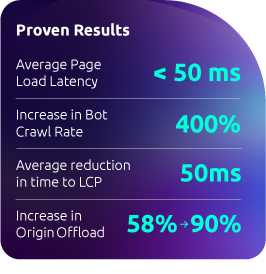
Search engine bots with limited crawl budgets can struggle to index everything for vast, ever-changing product catalogs. To accelerate indexing, Harper can identify SEO bot traffic and deliver an optimized “base page” that takes less time to deliver and less time to crawl. By leveraging this targeted approach, companies have seen crawl rates increase by as much as 400%.

Full Page Delivery

Extending the SEO Bot Page Caching use case, Harper can deliver those same compiled pages to all users- especially important when extremely large catalogs exceed CDN limitations. Harper can also build pages at the edge, with personalization and dynamic content such as pricing and recommendations— using popular NodeJS frameworks like NextJS.  

Edge DR (Disaster Recovery)

Harper’s distributed nature offers massive redundancy. As such, using our platform for Full Page Delivery (either origin-compiled or edge-assembled) also provides you a turn-key solution if your origin experiences an outage, ensuring customers can still navigate your catalog while you get things back up and running.

Get Started

Contact Harper today to discuss your website performance challenges with a Distributed Systems Architect for tailored recommendations.

Performance Challenges

E-commerce success hinges on delivering fast and efficient web pages. However, achieving optimal SEO and user experience can be challenging with vast or dynamic product catalogs. Traditional tech stacks simply can’t keep up. Common challenges include:

Page Load Latency:

Excessive network hops and system complexity slow down product pages, impacting search engine rankings.

Catalog Scale vs SEO Bot Performance:

For large product catalogs, SEO optimizations often outpace search engines’ ability to index them, limiting revenue potential.

Redirect Optimization:

Frequent catalog updates and optimizations can lead to convoluted, circular, or chained redirect logic that can negatively impact search rankings.

Core Web Vitals:

Optimizing TTFB, LCP, and INP is crucial for top search rankings, but often requires dynamic content capabilities working in concert with your CDN.

Performance Enhancement Strategies

Harper combines an API, In-Memory Cache, and High-Performance Database into a single package, delivering unmatched low latency, security, and value to your application. We then distribute and synchronize your applications and data close to every user, further improving latency and delivering unparalleled resiliency.

Most digital commerce customers encounter similar challenges as they scale, so Harper has created several open-source components that serve as starting points for site optimization. Our team of solution architects can work with you to select, configure, and deploy any number of these components to meet your performance goals, or you can clone and extend them yourself.

Early Hints

Improving core web vitals (CWV) by returning partial responses that outline assets to be downloaded before the page's HTML. Assets that benefit from early hints include hero images to help with LCP (Largest Contentful Paint) and other static assets such as CSS and JS files. The solution works seamlessly with your CDN to ensure the lowest possible latency, no matter how extensive your product catalog may be.   

Redirect Management

Frequent page and URL updates are all too common. As URLs shift, redirect chains can lengthen, significantly slowing page load times. Harper overcomes this challenge with submillisecond redirect lookups at the front edge of an SEO Service Fabric, getting customers to the right page without delay.  

SEO Bot Page Caching

Search engine bots with limited crawl budgets can struggle to index everything for vast, ever-changing product catalogs. To accelerate indexing, Harper can identify SEO bot traffic and deliver an optimized “base page” that takes less time to deliver and less time to crawl. By leveraging this targeted approach, companies have seen crawl rates increase by as much as 400%.

Full Page Delivery

Extending the SEO Bot Page Caching use case, Harper can deliver those same compiled pages to all users- especially important when extremely large catalogs exceed CDN limitations. Harper can also build pages at the edge, with personalization and dynamic content such as pricing and recommendations— using popular NodeJS frameworks like NextJS.  

Edge DR (Disaster Recovery)

Harper’s distributed nature offers massive redundancy. As such, using our platform for Full Page Delivery (either origin-compiled or edge-assembled) also provides you a turn-key solution if your origin experiences an outage, ensuring customers can still navigate your catalog while you get things back up and running.

Get Started

Contact Harper today to discuss your website performance challenges with a Distributed Systems Architect for tailored recommendations.

Harper’s collection of turn-key, enterprise-grade components is designed to improve performance and maximize revenue at any scale.

Download

White arrow pointing right
Harper’s collection of turn-key, enterprise-grade components is designed to improve performance and maximize revenue at any scale.

Download

White arrow pointing right
Harper’s collection of turn-key, enterprise-grade components is designed to improve performance and maximize revenue at any scale.

Download

White arrow pointing right

Explore Recent Resources

Blog
GitHub Logo

Why a Multi-Tier Cache Delivers Better ROI Than a CDN Alone

Learn why a multi-tier caching strategy combining a CDN and mid-tier cache delivers better ROI. Discover how deterministic caching, improved origin offload, lower tail latency, and predictable costs outperform a CDN-only architecture for modern applications.
Cache
Blog
Learn why a multi-tier caching strategy combining a CDN and mid-tier cache delivers better ROI. Discover how deterministic caching, improved origin offload, lower tail latency, and predictable costs outperform a CDN-only architecture for modern applications.
Person with short dark hair and moustache, wearing a colorful plaid shirt, smiling outdoors in a forested mountain landscape.
Aleks Haugom
Senior Manager of GTM & Marketing
Blog

Why a Multi-Tier Cache Delivers Better ROI Than a CDN Alone

Learn why a multi-tier caching strategy combining a CDN and mid-tier cache delivers better ROI. Discover how deterministic caching, improved origin offload, lower tail latency, and predictable costs outperform a CDN-only architecture for modern applications.
Aleks Haugom
Jan 2026
Blog

Why a Multi-Tier Cache Delivers Better ROI Than a CDN Alone

Learn why a multi-tier caching strategy combining a CDN and mid-tier cache delivers better ROI. Discover how deterministic caching, improved origin offload, lower tail latency, and predictable costs outperform a CDN-only architecture for modern applications.
Aleks Haugom
Blog

Why a Multi-Tier Cache Delivers Better ROI Than a CDN Alone

Learn why a multi-tier caching strategy combining a CDN and mid-tier cache delivers better ROI. Discover how deterministic caching, improved origin offload, lower tail latency, and predictable costs outperform a CDN-only architecture for modern applications.
Aleks Haugom
Tutorial
GitHub Logo

Real-Time Pub/Sub Without the "Stack"

Explore a real-time pub/sub architecture where MQTT, WebSockets, Server-Sent Events, and REST work together with persistent data storage in one end-to-end system, enabling real-time interoperability, stateful messaging, and simplified service-to-device and browser communication.
Harper Learn
Tutorial
Explore a real-time pub/sub architecture where MQTT, WebSockets, Server-Sent Events, and REST work together with persistent data storage in one end-to-end system, enabling real-time interoperability, stateful messaging, and simplified service-to-device and browser communication.
A man with short dark hair, glasses, and a goatee smiles slightly, wearing a black shirt in front of a nature background.
Ivan R. Judson, Ph.D.
Distinguished Solution Architect
Tutorial

Real-Time Pub/Sub Without the "Stack"

Explore a real-time pub/sub architecture where MQTT, WebSockets, Server-Sent Events, and REST work together with persistent data storage in one end-to-end system, enabling real-time interoperability, stateful messaging, and simplified service-to-device and browser communication.
Ivan R. Judson, Ph.D.
Jan 2026
Tutorial

Real-Time Pub/Sub Without the "Stack"

Explore a real-time pub/sub architecture where MQTT, WebSockets, Server-Sent Events, and REST work together with persistent data storage in one end-to-end system, enabling real-time interoperability, stateful messaging, and simplified service-to-device and browser communication.
Ivan R. Judson, Ph.D.
Tutorial

Real-Time Pub/Sub Without the "Stack"

Explore a real-time pub/sub architecture where MQTT, WebSockets, Server-Sent Events, and REST work together with persistent data storage in one end-to-end system, enabling real-time interoperability, stateful messaging, and simplified service-to-device and browser communication.
Ivan R. Judson, Ph.D.
News
GitHub Logo

Harper Recognized on Built In’s 2026 Best Places to Work in Colorado Lists

Harper is honored as a Built In 2026 Best Startup to Work For and Best Place to Work in Colorado, recognizing its people-first culture, strong employee experience, and values of accountability, authenticity, empowerment, focus, and transparency that help teams thrive and grow together.
Announcement
News
Harper is honored as a Built In 2026 Best Startup to Work For and Best Place to Work in Colorado, recognizing its people-first culture, strong employee experience, and values of accountability, authenticity, empowerment, focus, and transparency that help teams thrive and grow together.
Colorful geometric illustration of a dog's head resembling folded paper art in shades of teal and pink.
Harper
News

Harper Recognized on Built In’s 2026 Best Places to Work in Colorado Lists

Harper is honored as a Built In 2026 Best Startup to Work For and Best Place to Work in Colorado, recognizing its people-first culture, strong employee experience, and values of accountability, authenticity, empowerment, focus, and transparency that help teams thrive and grow together.
Harper
Jan 2026
News

Harper Recognized on Built In’s 2026 Best Places to Work in Colorado Lists

Harper is honored as a Built In 2026 Best Startup to Work For and Best Place to Work in Colorado, recognizing its people-first culture, strong employee experience, and values of accountability, authenticity, empowerment, focus, and transparency that help teams thrive and grow together.
Harper
News

Harper Recognized on Built In’s 2026 Best Places to Work in Colorado Lists

Harper is honored as a Built In 2026 Best Startup to Work For and Best Place to Work in Colorado, recognizing its people-first culture, strong employee experience, and values of accountability, authenticity, empowerment, focus, and transparency that help teams thrive and grow together.
Harper
Comparison
GitHub Logo

Harper vs. Standard Microservices: Performance Comparison Benchmark

A detailed performance benchmark comparing a traditional microservices architecture with Harper’s unified runtime. Using a real, fully functional e-commerce application, this report examines latency, scalability, and architectural overhead across homepage, category, and product pages, highlighting the real-world performance implications between two different styles of distributed systems.
Comparison
A detailed performance benchmark comparing a traditional microservices architecture with Harper’s unified runtime. Using a real, fully functional e-commerce application, this report examines latency, scalability, and architectural overhead across homepage, category, and product pages, highlighting the real-world performance implications between two different styles of distributed systems.
Person with short dark hair and moustache, wearing a colorful plaid shirt, smiling outdoors in a forested mountain landscape.
Aleks Haugom
Senior Manager of GTM & Marketing
Comparison

Harper vs. Standard Microservices: Performance Comparison Benchmark

A detailed performance benchmark comparing a traditional microservices architecture with Harper’s unified runtime. Using a real, fully functional e-commerce application, this report examines latency, scalability, and architectural overhead across homepage, category, and product pages, highlighting the real-world performance implications between two different styles of distributed systems.
Aleks Haugom
Dec 2025
Comparison

Harper vs. Standard Microservices: Performance Comparison Benchmark

A detailed performance benchmark comparing a traditional microservices architecture with Harper’s unified runtime. Using a real, fully functional e-commerce application, this report examines latency, scalability, and architectural overhead across homepage, category, and product pages, highlighting the real-world performance implications between two different styles of distributed systems.
Aleks Haugom
Comparison

Harper vs. Standard Microservices: Performance Comparison Benchmark

A detailed performance benchmark comparing a traditional microservices architecture with Harper’s unified runtime. Using a real, fully functional e-commerce application, this report examines latency, scalability, and architectural overhead across homepage, category, and product pages, highlighting the real-world performance implications between two different styles of distributed systems.
Aleks Haugom
Tutorial
GitHub Logo

A Simpler Real-Time Messaging Architecture with MQTT, WebSockets, and SSE

Learn how to build a unified real-time backbone using Harper with MQTT, WebSockets, and Server-Sent Events. This guide shows how to broker messages, fan out real-time data, and persist events in one runtime—simplifying real-time system architecture for IoT, dashboards, and event-driven applications.
Harper Learn
Tutorial
Learn how to build a unified real-time backbone using Harper with MQTT, WebSockets, and Server-Sent Events. This guide shows how to broker messages, fan out real-time data, and persist events in one runtime—simplifying real-time system architecture for IoT, dashboards, and event-driven applications.
A man with short dark hair, glasses, and a goatee smiles slightly, wearing a black shirt in front of a nature background.
Ivan R. Judson, Ph.D.
Distinguished Solution Architect
Tutorial

A Simpler Real-Time Messaging Architecture with MQTT, WebSockets, and SSE

Learn how to build a unified real-time backbone using Harper with MQTT, WebSockets, and Server-Sent Events. This guide shows how to broker messages, fan out real-time data, and persist events in one runtime—simplifying real-time system architecture for IoT, dashboards, and event-driven applications.
Ivan R. Judson, Ph.D.
Dec 2025
Tutorial

A Simpler Real-Time Messaging Architecture with MQTT, WebSockets, and SSE

Learn how to build a unified real-time backbone using Harper with MQTT, WebSockets, and Server-Sent Events. This guide shows how to broker messages, fan out real-time data, and persist events in one runtime—simplifying real-time system architecture for IoT, dashboards, and event-driven applications.
Ivan R. Judson, Ph.D.
Tutorial

A Simpler Real-Time Messaging Architecture with MQTT, WebSockets, and SSE

Learn how to build a unified real-time backbone using Harper with MQTT, WebSockets, and Server-Sent Events. This guide shows how to broker messages, fan out real-time data, and persist events in one runtime—simplifying real-time system architecture for IoT, dashboards, and event-driven applications.
Ivan R. Judson, Ph.D.