



Click Below to Get the Code

Browse, clone, and build from real-world templates powered by Harper.
Case Study
GitHub Logo

E-Commerce Holiday Showdown

Learn how a Fortune 100 retailer accelerated their website's performance to outrank Amazon.com product pages on Google.
Digital Commerce
Case Study
Digital Commerce

E-Commerce Holiday Showdown

By
Harper
March 18, 2025
By
Harper
March 18, 2025
By
Harper
March 18, 2025
March 18, 2025
Learn how a Fortune 100 retailer accelerated their website's performance to outrank Amazon.com product pages on Google.
Harper

Challenge

Preparing for the upcoming 2023 holiday season, a Fortune 100 retailer was aiming to have their product pages outrank Amazon for the top spots on Google Search. With all other optimizations in place, the remaining challenge was improving page load times. Having reached limitations with their primary CDN, the solution needed to augment their existing technology stack with minimal lift or disruption. Due to the retailer's extensive product catalog, over 40% of page lookups resulted in a CDN cache miss. Based on the retailer's estimates, accelerating the remaining 40% of product pages could increase revenue by as much as $100 million over the year. 

This case study examines how this major retailer implemented a Harper cache to secure the winning position for its product pages. 


‍

Highlighted Performance Metrics

Solution

In August 2023, Akamai approached Harper to help accelerate page load times for one of their largest retail customers. The metric to focus on was the average time to LCP (Largest Contentful Paint), which required low-latency delivery of hero image metadata that allowed those images to preload, speeding up LCP. Akamai CDN already delivered these image hints for approximately 58% of product page loads. However, the remaining 42% of page loads were not accelerated due to the limitations of the existing shared CDN infrastructure.

Delivering image hint metadata for the outstanding 42% of page requests required holding tens of millions of keys in a long-tail cache so that even the most infrequently visited pages would perform well when search engine crawlers came upon them.  

Harper was the ideal technology to meet this need, given its built-in application engine, in-memory caching capabilities, and ease of distribution. Ultimately, the retail team utilized Harper as a secondary layer behind Akamai's Ion CDN, which was already delivering a lightning-fast response for most requests. 
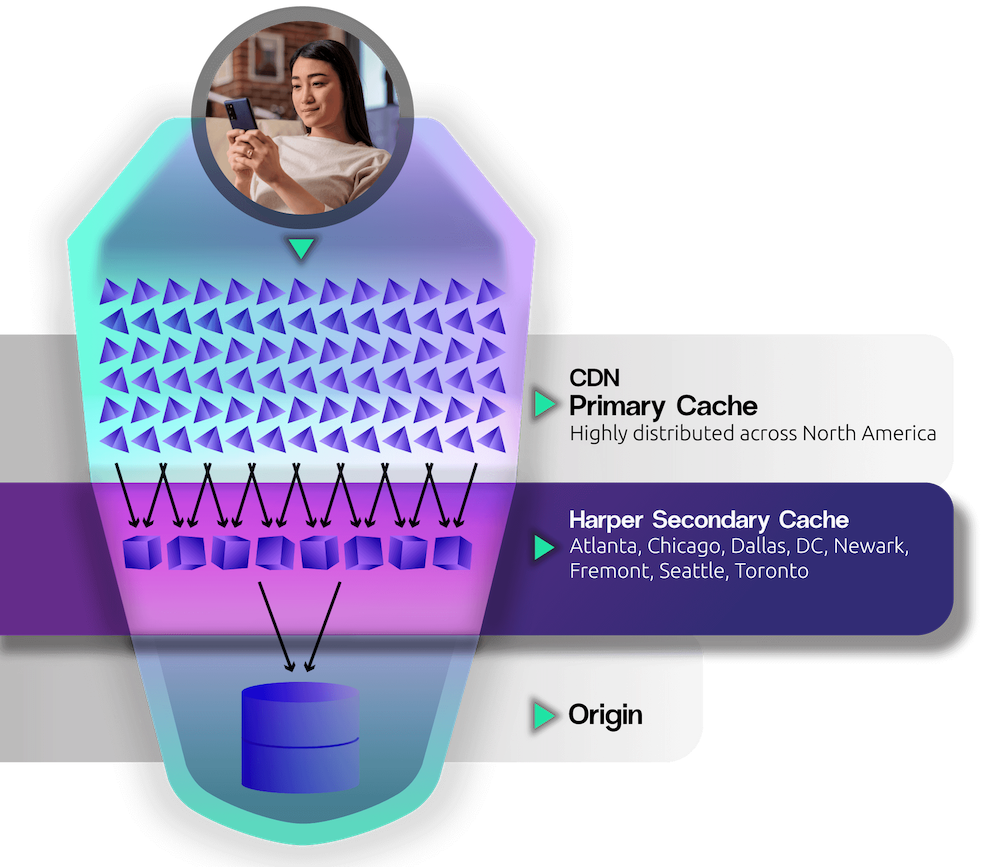
Harper Cache Diagram


‍
‍

Results

In September 2023, the solution was deployed to eight Akamai Connected Cloud locations across North America. Within days, the Harper cache layer held over 85 million keys in-memory while delivering a P50 lookup time of 0.36 ms (millisecond) and a P95 of 1.3 ms. Most importantly, the retailer saw a 50ms average improvement in time to LCP, representing a notable leap for their already impressive infrastructure.

Further, the retailer saw a 30% decrease in origin requests, with Harper accelerating over 550 million page loads during the holiday season. This helped increase revenue while reducing origin server load even during the busiest time of year. 

‍

What’s Next

Impressed by the rapid time to value and high performance delivered by Harper, the retailer is already implementing broader use cases of Harper to help streamline their systems, reduce costs, and improve performance.

‍

Akamai and Harper, Better Together

Harper’s distributed systems platform works seamlessly with Akamai’s Security and CDN products. This integration allows Akamai customers to enjoy managed services for even the most complex requirements. Combining Harper’s unified architecture strategy and Akamai’s value-oriented infrastructure ensures that managed services are cost-efficient, highly performant, and exceptionally resilient. Contact us to learn more about Harpers Commerce Optimization Suite of proven solutions.


‍

Challenge

Preparing for the upcoming 2023 holiday season, a Fortune 100 retailer was aiming to have their product pages outrank Amazon for the top spots on Google Search. With all other optimizations in place, the remaining challenge was improving page load times. Having reached limitations with their primary CDN, the solution needed to augment their existing technology stack with minimal lift or disruption. Due to the retailer's extensive product catalog, over 40% of page lookups resulted in a CDN cache miss. Based on the retailer's estimates, accelerating the remaining 40% of product pages could increase revenue by as much as $100 million over the year. 

This case study examines how this major retailer implemented a Harper cache to secure the winning position for its product pages. 


‍

Highlighted Performance Metrics

Solution

In August 2023, Akamai approached Harper to help accelerate page load times for one of their largest retail customers. The metric to focus on was the average time to LCP (Largest Contentful Paint), which required low-latency delivery of hero image metadata that allowed those images to preload, speeding up LCP. Akamai CDN already delivered these image hints for approximately 58% of product page loads. However, the remaining 42% of page loads were not accelerated due to the limitations of the existing shared CDN infrastructure.

Delivering image hint metadata for the outstanding 42% of page requests required holding tens of millions of keys in a long-tail cache so that even the most infrequently visited pages would perform well when search engine crawlers came upon them.  

Harper was the ideal technology to meet this need, given its built-in application engine, in-memory caching capabilities, and ease of distribution. Ultimately, the retail team utilized Harper as a secondary layer behind Akamai's Ion CDN, which was already delivering a lightning-fast response for most requests. 

Harper Cache Diagram


‍
‍

Results

In September 2023, the solution was deployed to eight Akamai Connected Cloud locations across North America. Within days, the Harper cache layer held over 85 million keys in-memory while delivering a P50 lookup time of 0.36 ms (millisecond) and a P95 of 1.3 ms. Most importantly, the retailer saw a 50ms average improvement in time to LCP, representing a notable leap for their already impressive infrastructure.

Further, the retailer saw a 30% decrease in origin requests, with Harper accelerating over 550 million page loads during the holiday season. This helped increase revenue while reducing origin server load even during the busiest time of year. 

‍

What’s Next

Impressed by the rapid time to value and high performance delivered by Harper, the retailer is already implementing broader use cases of Harper to help streamline their systems, reduce costs, and improve performance.

‍

Akamai and Harper, Better Together

Harper’s distributed systems platform works seamlessly with Akamai’s Security and CDN products. This integration allows Akamai customers to enjoy managed services for even the most complex requirements. Combining Harper’s unified architecture strategy and Akamai’s value-oriented infrastructure ensures that managed services are cost-efficient, highly performant, and exceptionally resilient. Contact us to learn more about Harpers Commerce Optimization Suite of proven solutions.

‍

Learn how a Fortune 100 retailer accelerated their website's performance to outrank Amazon.com product pages on Google.

Download

White arrow pointing right
Learn how a Fortune 100 retailer accelerated their website's performance to outrank Amazon.com product pages on Google.

Download

White arrow pointing right
Learn how a Fortune 100 retailer accelerated their website's performance to outrank Amazon.com product pages on Google.

Download

White arrow pointing right

Explore Recent Resources

Blog
GitHub Logo

Why a Multi-Tier Cache Delivers Better ROI Than a CDN Alone

Learn why a multi-tier caching strategy combining a CDN and mid-tier cache delivers better ROI. Discover how deterministic caching, improved origin offload, lower tail latency, and predictable costs outperform a CDN-only architecture for modern applications.
Cache
Blog
Learn why a multi-tier caching strategy combining a CDN and mid-tier cache delivers better ROI. Discover how deterministic caching, improved origin offload, lower tail latency, and predictable costs outperform a CDN-only architecture for modern applications.
Person with short dark hair and moustache, wearing a colorful plaid shirt, smiling outdoors in a forested mountain landscape.
Aleks Haugom
Senior Manager of GTM & Marketing
Blog

Why a Multi-Tier Cache Delivers Better ROI Than a CDN Alone

Learn why a multi-tier caching strategy combining a CDN and mid-tier cache delivers better ROI. Discover how deterministic caching, improved origin offload, lower tail latency, and predictable costs outperform a CDN-only architecture for modern applications.
Aleks Haugom
Jan 2026
Blog

Why a Multi-Tier Cache Delivers Better ROI Than a CDN Alone

Learn why a multi-tier caching strategy combining a CDN and mid-tier cache delivers better ROI. Discover how deterministic caching, improved origin offload, lower tail latency, and predictable costs outperform a CDN-only architecture for modern applications.
Aleks Haugom
Blog

Why a Multi-Tier Cache Delivers Better ROI Than a CDN Alone

Learn why a multi-tier caching strategy combining a CDN and mid-tier cache delivers better ROI. Discover how deterministic caching, improved origin offload, lower tail latency, and predictable costs outperform a CDN-only architecture for modern applications.
Aleks Haugom
Tutorial
GitHub Logo

Real-Time Pub/Sub Without the "Stack"

Explore a real-time pub/sub architecture where MQTT, WebSockets, Server-Sent Events, and REST work together with persistent data storage in one end-to-end system, enabling real-time interoperability, stateful messaging, and simplified service-to-device and browser communication.
Harper Learn
Tutorial
Explore a real-time pub/sub architecture where MQTT, WebSockets, Server-Sent Events, and REST work together with persistent data storage in one end-to-end system, enabling real-time interoperability, stateful messaging, and simplified service-to-device and browser communication.
A man with short dark hair, glasses, and a goatee smiles slightly, wearing a black shirt in front of a nature background.
Ivan R. Judson, Ph.D.
Distinguished Solution Architect
Tutorial

Real-Time Pub/Sub Without the "Stack"

Explore a real-time pub/sub architecture where MQTT, WebSockets, Server-Sent Events, and REST work together with persistent data storage in one end-to-end system, enabling real-time interoperability, stateful messaging, and simplified service-to-device and browser communication.
Ivan R. Judson, Ph.D.
Jan 2026
Tutorial

Real-Time Pub/Sub Without the "Stack"

Explore a real-time pub/sub architecture where MQTT, WebSockets, Server-Sent Events, and REST work together with persistent data storage in one end-to-end system, enabling real-time interoperability, stateful messaging, and simplified service-to-device and browser communication.
Ivan R. Judson, Ph.D.
Tutorial

Real-Time Pub/Sub Without the "Stack"

Explore a real-time pub/sub architecture where MQTT, WebSockets, Server-Sent Events, and REST work together with persistent data storage in one end-to-end system, enabling real-time interoperability, stateful messaging, and simplified service-to-device and browser communication.
Ivan R. Judson, Ph.D.
News
GitHub Logo

Harper Recognized on Built In’s 2026 Best Places to Work in Colorado Lists

Harper is honored as a Built In 2026 Best Startup to Work For and Best Place to Work in Colorado, recognizing its people-first culture, strong employee experience, and values of accountability, authenticity, empowerment, focus, and transparency that help teams thrive and grow together.
Announcement
News
Harper is honored as a Built In 2026 Best Startup to Work For and Best Place to Work in Colorado, recognizing its people-first culture, strong employee experience, and values of accountability, authenticity, empowerment, focus, and transparency that help teams thrive and grow together.
Colorful geometric illustration of a dog's head resembling folded paper art in shades of teal and pink.
Harper
News

Harper Recognized on Built In’s 2026 Best Places to Work in Colorado Lists

Harper is honored as a Built In 2026 Best Startup to Work For and Best Place to Work in Colorado, recognizing its people-first culture, strong employee experience, and values of accountability, authenticity, empowerment, focus, and transparency that help teams thrive and grow together.
Harper
Jan 2026
News

Harper Recognized on Built In’s 2026 Best Places to Work in Colorado Lists

Harper is honored as a Built In 2026 Best Startup to Work For and Best Place to Work in Colorado, recognizing its people-first culture, strong employee experience, and values of accountability, authenticity, empowerment, focus, and transparency that help teams thrive and grow together.
Harper
News

Harper Recognized on Built In’s 2026 Best Places to Work in Colorado Lists

Harper is honored as a Built In 2026 Best Startup to Work For and Best Place to Work in Colorado, recognizing its people-first culture, strong employee experience, and values of accountability, authenticity, empowerment, focus, and transparency that help teams thrive and grow together.
Harper
Comparison
GitHub Logo

Harper vs. Standard Microservices: Performance Comparison Benchmark

A detailed performance benchmark comparing a traditional microservices architecture with Harper’s unified runtime. Using a real, fully functional e-commerce application, this report examines latency, scalability, and architectural overhead across homepage, category, and product pages, highlighting the real-world performance implications between two different styles of distributed systems.
Comparison
A detailed performance benchmark comparing a traditional microservices architecture with Harper’s unified runtime. Using a real, fully functional e-commerce application, this report examines latency, scalability, and architectural overhead across homepage, category, and product pages, highlighting the real-world performance implications between two different styles of distributed systems.
Person with short dark hair and moustache, wearing a colorful plaid shirt, smiling outdoors in a forested mountain landscape.
Aleks Haugom
Senior Manager of GTM & Marketing
Comparison

Harper vs. Standard Microservices: Performance Comparison Benchmark

A detailed performance benchmark comparing a traditional microservices architecture with Harper’s unified runtime. Using a real, fully functional e-commerce application, this report examines latency, scalability, and architectural overhead across homepage, category, and product pages, highlighting the real-world performance implications between two different styles of distributed systems.
Aleks Haugom
Dec 2025
Comparison

Harper vs. Standard Microservices: Performance Comparison Benchmark

A detailed performance benchmark comparing a traditional microservices architecture with Harper’s unified runtime. Using a real, fully functional e-commerce application, this report examines latency, scalability, and architectural overhead across homepage, category, and product pages, highlighting the real-world performance implications between two different styles of distributed systems.
Aleks Haugom
Comparison

Harper vs. Standard Microservices: Performance Comparison Benchmark

A detailed performance benchmark comparing a traditional microservices architecture with Harper’s unified runtime. Using a real, fully functional e-commerce application, this report examines latency, scalability, and architectural overhead across homepage, category, and product pages, highlighting the real-world performance implications between two different styles of distributed systems.
Aleks Haugom
Tutorial
GitHub Logo

A Simpler Real-Time Messaging Architecture with MQTT, WebSockets, and SSE

Learn how to build a unified real-time backbone using Harper with MQTT, WebSockets, and Server-Sent Events. This guide shows how to broker messages, fan out real-time data, and persist events in one runtime—simplifying real-time system architecture for IoT, dashboards, and event-driven applications.
Harper Learn
Tutorial
Learn how to build a unified real-time backbone using Harper with MQTT, WebSockets, and Server-Sent Events. This guide shows how to broker messages, fan out real-time data, and persist events in one runtime—simplifying real-time system architecture for IoT, dashboards, and event-driven applications.
A man with short dark hair, glasses, and a goatee smiles slightly, wearing a black shirt in front of a nature background.
Ivan R. Judson, Ph.D.
Distinguished Solution Architect
Tutorial

A Simpler Real-Time Messaging Architecture with MQTT, WebSockets, and SSE

Learn how to build a unified real-time backbone using Harper with MQTT, WebSockets, and Server-Sent Events. This guide shows how to broker messages, fan out real-time data, and persist events in one runtime—simplifying real-time system architecture for IoT, dashboards, and event-driven applications.
Ivan R. Judson, Ph.D.
Dec 2025
Tutorial

A Simpler Real-Time Messaging Architecture with MQTT, WebSockets, and SSE

Learn how to build a unified real-time backbone using Harper with MQTT, WebSockets, and Server-Sent Events. This guide shows how to broker messages, fan out real-time data, and persist events in one runtime—simplifying real-time system architecture for IoT, dashboards, and event-driven applications.
Ivan R. Judson, Ph.D.
Tutorial

A Simpler Real-Time Messaging Architecture with MQTT, WebSockets, and SSE

Learn how to build a unified real-time backbone using Harper with MQTT, WebSockets, and Server-Sent Events. This guide shows how to broker messages, fan out real-time data, and persist events in one runtime—simplifying real-time system architecture for IoT, dashboards, and event-driven applications.
Ivan R. Judson, Ph.D.